Conservatory of Arts, Aesthetics, Cultural Traditions, and Developmental Studies
Anād Khaṅḍ is envisioned as the Foundation’s conservatory and living-learning space for the study, conservation, practice, documentation, and transmission of tangible and intangible heritage.
Earlier described as the Anād Conservatory, this initiative is now being developed under the broader name Anād Khaṅḍ — a space of learning, discipline, memory, practice, craft, research, and public engagement.
The word khaṅḍ evokes a field, realm, or dedicated zone of work and growth. For Anād, it signifies a living domain where knowledge is not merely preserved in storage, but recovered, practised, taught, documented, interpreted, and carried forward.
 Vision

Anād Khaṅḍ is not conceived as a conventional museum, music school, archive, gallery, or retreat centre alone. It is envisioned as an integrated conservatory where tangible and intangible heritage meet:
- manuscripts, archives, books, photographs, recordings, films, instruments, tools, textiles, calligraphic works, paper, inks, pigments, colours, and binding traditions;
- oral histories, rāga-tāla systems, pedagogy, craft knowledge, performance practice, memory, language, embodied techniques, and living traditions;
- research, documentation, conservation, teaching, publication, public learning, and intergenerational transmission.
The aim is to create conditions where heritage can remain a living discipline rather than a decorative relic.
Core Areas of Work
1. Gurbāṇī Saṅgīt and the Music of Srī Gurū Granth Sāhib
Anād Khaṅḍ supports the study, teaching, documentation, and transmission of Gurbāṇī Saṅgīt and the music of Srī Gurū Granth Sāhib, including rāga, tāla, repertoire, notations, instruments, oral pedagogy, performance practices, and associated craft traditions.
2. Musical Instruments and Luthiery
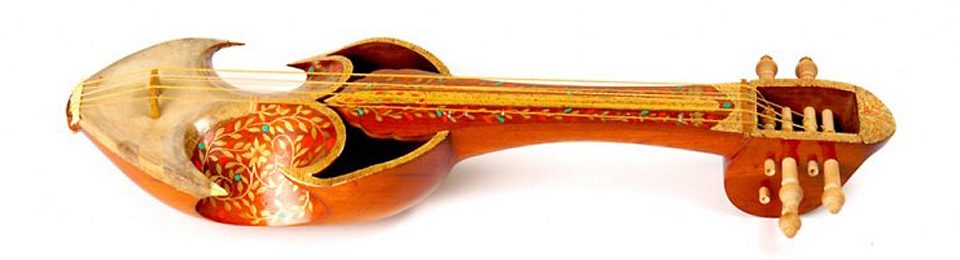
The conservatory supports the research, conservation, revival, making, repair, documentation, and teaching of heritage instruments such as rabāb, tāus, sarindā, jōṛī, pakhāwaj, mridaṅg, and related instruments.
This work includes the wider craft ecology of instrument-making: woodworking, leatherwork, string-making, metalwork, bow-making, tool-making, finishing, storage, maintenance, and performance-use knowledge.
3. Archives, Manuscripts and Audio-Visual Heritage
Anād Khaṅḍ is intended to house and support archival work relating to manuscripts, books, rare prints, photographs, negatives, transparencies, recordings, cassettes, audio tapes, films, field recordings, oral histories, and digital collections.
This includes preventive conservation, cataloguing, metadata preparation, digitisation, scanning, audio-visual restoration, storage, backup systems, and research access where appropriate.
4. Calligraphy, Paper, Ink, and Manuscript Arts
The conservatory may support the study, documentation, practice, revival, and teaching of calligraphy, scribal traditions, manuscript preparation, traditional paper-making, ink-making, pigment and colour preparation, stone, mineral and plant-based colours, binding, folio preparation, writing implements, reed, bamboo and metal nibs, brushes, burnishing tools, paper-sizing, and related manuscript-craft ecologies.
These traditions are central to the material and intellectual life of manuscripts, books, archives, and sacred / literary / artistic transmission.

5. Vernacular Skills and Craft Traditions
Anād Khaṅḍ may support vernacular skills and hand-based knowledge systems, including woodworking, metalwork, leatherwork, weaving, spinning, phulkārī, paper, ink, pigment, calligraphy, binding, tool-making, textile traditions, attire traditions, and other craft practices connected with cultural memory and livelihood dignity.
6. Anād Dehātī Vastra
Subject to available resources, Anād Khaṅḍ may include a research and documentation stream tentatively named Anād Dehātī Vastra, focused on vernacular attire, regional wearing practices, turbans, drape, cloth traditions, rural and hereditary performer attire, period garments, tailoring memory, seamster traditions, textile references, and endangered garment knowledge systems.
7. Education and Public Learning
Anād Khaṅḍ may host classes, workshops, retreats, residencies, fellowships, apprenticeships, lecture-demonstrations, public talks, student visits, scholarly access, exhibitions, viewing and listening sessions, and other educational programmes.
Such learning may be formal or informal, short-term or long-term, in-person or digital, and may include future curriculum-based initiatives subject to applicable approvals wherever required.
Living Transmission
Anād Khaṅḍ is based on the conviction that living heritage requires more than preservation. It requires disciplined practice, patient documentation, trained hands, informed listeners, careful readers, responsible institutions, and intergenerational relationships.
A manuscript must be read and conserved.
An instrument must be sounded, repaired, and understood.
A rāga must be taught with memory and method.
A craft must remain in living hands.
A recording must be restored and contextualised.
A tradition-bearer must be heard while living.
Institutional Role
Anād Khaṅḍ may function through archives, studios, classrooms, workshops, libraries, galleries, conservation spaces, documentation units, digital platforms, research cells, publication units, and public-learning programmes.
It may work in collaboration with scholars, artisans, musicians, conservators, educators, designers, archivists, craft practitioners, donors, CSR contributors, public institutions, private collections, and community knowledge-bearers.
Its purpose is to create a responsible institutional home where sthūl virsā — tangible heritage — and sūkham virsā — intangible heritage — can be studied, conserved, taught, displayed, practised, and transmitted for public benefit.
Historical Context
The Anād Conservatory vision has evolved through earlier proposals, including work imagined for Sultanpur Lodhi and other heritage spaces. Those earlier ideas remain part of the Foundation’s institutional history. The present Anād Khaṅḍ framework carries that vision forward in a wider and more flexible form, allowing the Foundation to develop archives, conservatory spaces, heritage-transmission centres, craft workshops, learning facilities, and conservation-linked public programmes wherever feasible and lawful.
Purpose
Anād Khaṅḍ seeks to make heritage usable without exploiting it, accessible without trivialising it, and alive without severing it from memory.
It is intended as a space where research, conservation, pedagogy, craft, archive, performance, publication, and public learning can meet in the service of living cultural continuity.
Dear Bhai Baldeep Singh:
You are doing a great service to the neglected town of Sultanpur Lodhi. It is good that this town was spared the bulldozing by the forces of so called modernization. I think this town should be opened to foreign tourists to see its ruins and some historic preservation. The route of the tourists should be cleaned up and the five centuries old fort and the monument across Kaali Vein should be shown to the foreign tourists.
Thank you for your comment Ji.
It may look from far that the ‘forces’ have spared this town but it is not so.
There was one top ranking police officer over 2 decades ago who sold thousands of old bricks from the Qila while most others have been either helpless bystanders or have had no value for heritage. For them ’tis just an ol’ building and they must now rebuild’!
Music is dead while other values aren’t thriving either.
But with people awake and aware, the dynamics of this once beautiful township can indeed be revived.
Sadly, the tourism department has played havoc in the recent years and alienated people. The projects in which they have intervened attempting conservation have been horribly handled – their shoddy work in the name of conservation on the Lahore Gate of the Qila Sarai, for example, has nearly destroyed this precious relic.
Real estate greed is random with people swarming around blindly for a quick buck.
In the midst of all this, I find myself still trying to make a sense of it all. But with the blessings and a proactive role played by the community elders (including you sire!), the odds can be overcome —basant it will again be…
Let us show just the Gurdwara Ber Sahib, the five century old Lodhi Fort and the lone Lodhi Dynasty Monument across the Black rivulet to the tourists.
Ji…