• About The Anād Foundation
    • Aims & Objectives
    • Governance
      • Board of Advisors 2026-2029
      • ASHA 2026–2029
    • Trustees & Associates
    • Historical Records
      • Founder Trustees
        • Bhāī Baldeep Singh
          • First visit to the Qila
        • Chiranjiv Singh
        • K. T. S. Tulsi
        • Kiranjit Singh Bawa
        • Manjit Kirpal Singh
        • Pervinder Singh Chandhok
        • Raj M. S. Liberhan
        • Ranjodh Singh
        • Ravinder Singh Ahuja
      • Board of Advisors
        • Rear Admiral Kirpal Singh, AVSM
        • Major H. P. S. Ahluwalia
      • Associate Trustees 2008-2011
      • Associate Trustees 2011-2014
      • Associate Trustees 2014-2017
        • Mayank Singh Bawa
      • Associate Trustees 2017-2020
      • Associate Trustees 2020-2023
    • Team & Project Associates
    • Financial Highlights — Archival Record
  • Anād Khaṅḍ / Conservatory
    • Anād Khaṅḍ — The Proposal
    • The Institute
      • Faculty
        • Resident Faculty
        • Visiting Faculty
      • Learning Streams
        • Class With Bhāī Baldeep Singh
        • After-School Studies
          • AAS Study Programme Coordination Committee Meeting I & II
      • Workshops
        • Gurbāṇī Saṅgīt Workshops
          • With Bhai Gurcharan Singh
          • With Bhai Baldeep Singh
            • BBS I
          • With Ustad Harbhajan Singh Namdhari
        • Dance Workshops
          • Kathak with Maria Maurizia Costanzo
            • Maurizia’s Workshop Note
            • Gallery
          • Chhau Dance with Luisa Spagna
            • A Note by Luisa Spagna
        • Theatre Workshops
          • With Kuljeet Singh
            • Theatre in the spaces
            • Gallery
        • Photography
      • Outreach
        • 2018: Poznań, Poland
        • 2019: Poznań, Poland
        • 2025: Rovigo, Italy
      • Gallery
    • ANĀD Scientific Advisory Committee 2009-2017
      • First Thoughts
        • By Professor Paolo Ceccarelli
        • By Professor Rabindra Vasavada
        • By Ashok B Lall
    • Costs and Funding Framework
    • Luthiery School
      • Rabāb
        • Harbhajan Kaur’s Rabab
      • Saranda
      • Taus
    • Audio-Visual Restoration Studio
  • Gurū Gaurav 350
    • Guru Gobind Singh — A Prophet With Difference
    • Gurū Gaurav — A Concept Note
    • Gurū Gaurav — Press Release
    • Performers
      • Rânsubāi
        • Inauguration
        • Raghuvir Mallik
        • Sangeet Kumar Pathak
        • Bibi Ashupreet Kaur
        • Ashutosh Upadhyay
        • Dr. Alankar Singh
        • Vidushi Jyoti Hegde
        • Bhai Baldeep Singh
        • Pandit Ram Kumar Mallick
        • Bhai Balbir Singh Ragi
        • Bhai Baldeep Singh —Poetry Reading
        • Pandit Rajendra Gangani
        • Pandit Yashpaul
        • Mohan Shyam Sharma
        • Jagat Narayan Pathak
        • Nihal Singh
        • Indra Kishore Mishra
        • Dr. Anil Chaudhary
      • January 1, 2017
        • Guru Gaurav Event Hosts
        • Introductions
        • Pandit Ravi Shankar Upadhyay
        • Dr. Ajit Pradhan
        • Dr. Nirinjan Kaur Khalsa
        • Ustad Asheesh Khan
        • Poet Kulwant Singh Grewal
        • Bhai Baljit Singh Namdhari
      • January 2, 2017
        • Dhaddi Desraj Lachkani
        • Poet Jaswant Singh Zafar
        • Parminder Singh Bhamra
        • Manu Seen
        • Shekhar Sen
        • Pandit Prem Kumar Mallick
      • January 3, 2017
        • Nashir Naqvi
        • Pandit Uday Kumar Mallick
        • Baha’ud’din Dagar
        • Vidushi Gopika Varma
        • Pandit Vinod Pathak
        • Jasbir Jassi
      • January 4, 2017
        • Pandit Ram Prakash Misra
        • Manganiārs
        • Samiran Sanyal
        • Dr. Gurinder Harnam Singh
        • Sukhwinder Amrit
        • Suvir Misra
        • Dr. Madan Gopal Singh
      • January 5, 2017
        • Jago Tareenjan Group
        • Dr. Francesca Cassio
        • Ustad Daud Khan Sadozai
        • Songs of the Khalsa
        • Dr. Ritwik Sanyal
        • Dr. Umayalpuram Sivaraman
        • Dr. Surjit Patar
        • Bhai Baldeep Singh —Gurbāni Pade
    • Review II by Professor Gajendra Narayan Singh
    • Production Team
  • Heritage Conservation
    • Intangible Heritage — Sūkham Virsā
      • Luthiery Tradition
    • Tangible Heritage — Sthūl Virsā
      • Qila Sultanpur Lodhi
        • Lahore Gate
          • Heritage Hammered by IP Singh
        • Darbar Hall
        • Old Kacchehri (Colonial structure)
        • Delhi Gate
        • Mosque
        • Qila Walls
    • Technology Partners
  • Punj-Care Initiatives
  • Events
    • Full Moon Events
      • May 2011
        • 6th Kāv Tarang Review
      • September 2011
        • Gallery
      • February 2012
      • October 2012
        • October 2012 Punya Baithak Gallery
        • 2012 10 29 Punyā Baithak Press Reviews
    • Poetry Festivals
      • 7th Anād Kāv Tarañg
    • Theatre
      • Story-telling by VK
    • Archives
    • Laya Darshan: Revealing the Riches of Indian Rhythm
    • Jashan 2006
    • 2008 Dharati Suhāvī
    • 2013 Harī Rāgu Gāthā: 31-Rāgu in Gurbāṇī
    • 2014 Hari Rāgu Gāthā: Singing of 31 Rāg in Gurbāṇī
    • Jashan 1915-2015
    • Gurū Nānak Dēv 550th
    • Virtual Vaisākhī 2020
    • 2020 Rai Radio3 — Dharati Suhāvī
    • 2020 Expressions on Nature: Dharati Suhāvī
  • Anād Awards
    • Award Jury
    • Anād Sanmān
      • Jashan 2006
        • Jashan 2006 Review
    • Kāv Sanmān
      • 2008
        • 2008 Review
      • 2009
        • 2009 Review
      • 2010
        • 2010 Review
      • 2011
  • Study at Anād
    • Gurbāṇī Saṅgīt Retreats
      • Retreat 25: Merced, California January 2010
        • Gallery
      • Retreat 26: London, Ontario
      • Retreat 27: Tucson Arizona January 2011
        • Love Poem
        • Gallery
      • Retreat 28: Espanola, New Mexico, July 2011
        • Amrita Kaur Khalsa
        • Gurkaran Singh
        • Guru Mander Kaur
        • Gurumukh Singh CPA
        • Harbhajan Kaur Khalsa
        • Keerat Kaur Chahal
        • Nihal Singh
        • Nirvair Kaur
        • Raviraj Singh
        • Siri Sevak Kaur Khalsa
        • Gallery
      • Retreat 29: London, Ontario 2011-12
        • Student Reviews
          • Keerat Kaur I
          • Keerat Kaur II
          • Baljinder Singh Bassi I
          • Baljinder Singh Bassi II
          • Baljinder Singh Bassi III
          • Tanvir Singh Suri I
          • Tanvir Singh Suri II
          • Harkamal Singh I
          • Raviraj Singh I
      • Retreat 30: Qila, Sultanpur Lodhi 2012
        • Concert inside Kapurthala’s Modern Reform Centre, February 18, 2012
        • Mid-term Review by Nirvair Kaur
        • Review by Nadar Nihal Singh
      • Retreat 31: Albuquerque, NM
        • Nirvair Kaur’s Review: 31st Albuquerque Summer Kirtan Course
        • Keerat Kaur’s 31st Summer Retreat Review
      • Retreat 32: Mississuaga, Ontario
        • Keerat Kaur’s Course Review
      • Retreat 40: Albuquerque, New Mexico
        • Gurbani Sangeet Retreat Review: Nihal Singh
      • Retreat 42: Rajgir, Bihar
      • Retreat 48th: New Delhi
      • Retreat 51: Online from Anād HQ
      • Retreat 52: Online from Anād Foundation HQ
      • Retreat 53: Rochester, MN
        • Rochester Preview & Screenshots
      • Retreat 54: Seattle, WA
      • Retreat 55: Seattle, WA
      • Retreat 56: San Francisco, California
      • Retreat 57: Surrey, BC
      • Retreat 58: San Francisco, California
      • Retreat 59: Khalsa Centre, Canada
    • Anād Online Classes Log
    • Internship Programmes
      • Vasant Valley School Class XI 3-week Internship 2012
        • Chairman’s letter to Vasant Valley School Internship Students
        • Delhi Head Office – Tentative Schedule
        • Student Reviews
          • Anmol Handa
          • Himmat Singh Guram
          • Kavya Rai
          • Luigi Hari Tehel Singh
          • Uday Talwar
          • Wanhee Ji
        • Vasant Valley School 2012 Internship – Images 1 – Delhi
  • YaarAnād
  • Contact Us
  • Donate / Support Anād
  • YaarAnād Virtual Baiṭhaks
    • YaarAnād Virtual Baiṭhak – Season I
      • 2020 April
      • 2020 May
      • 2020 June
      • 2020 July
      • 2020 August
      • 2020 September
      • 2020 October
      • 2020 November
    • YaarAnād Virtual Baiṭhak – Season II
      • 2020 December
      • 2021 January
      • 2021 February
      • 2021 March
      • 2021 April

The Anād Foundation

~ Culture | Conservation | Continuity

The Anād Foundation

Monthly Archives: June 2012

Gut-String Maker Mimmo Peruffo of Vicenza

29 Friday Jun 2012

Posted by bhaibaldeep in People

≈ Leave a comment

Years ago, when I was introduced to Mimmo, his story was chillingly similar to mine. As I had made a major transition from what I actually wanted to do this life time so sickeningly attracted to the flying machines to instead become a student and eventually a custodian of the gurus’ traditions, he was an engineer who got smitten by the art of making gut strings. Our similarities did not begin or end there – as I was meeting the last luthier (instrument maker), the last percussion maestro, the last people with the memory of the songs of the gurus – he was met with the last living exponent of gut string making in Napoli. He has recipes of how they transformed dead animals guts to live and vibrant tannd (gut-string), on beautifully handcrafted and shaped musical instruments, from the 12th century, the medieval and modern eras. The masters throughout were such romantics! The sixth string on the rabab is a master stroke by Mimmo – what would I be without my friends so endearing and precious!
In order to specify the strings of the rabab I have made for Harbhajan Kaur Khalsa of Millis, MA I visited Mimmo’s factory the day before (and yes, I missed the boring Portugallo-Spagna semi-finale) on June 27, 2012. I also met with master classical guitarist Andrea Ferigo of the Conservatorio Di Vicenza who also holds a Diploma in Sitar and also plays the instrument Sarod. Here are some images post-produced by Manpreet Singh:

Admiring the scroll – “Bravo Baldeep..!”
Measuring the strings that I dressed the Rabab with in Delhi.
Feeling the tautness.

Early processing stage.
Mid-way through the process.
Rinsing and checking.

These are like his babies – such passion he possess.
Close monitoring – remarkable it was when he said that there is one chemical (I will not reveal 😉 that he exposes the strings for exact 3 minutes..!
Careful rinsing – he estimated that he will have to return back at 01:00am in the night to start the next stage…

Spun and drying.
Imagine the myriad instruments that these will adorn..!
Maintaining the right humidity is one of the keys.

A point…
…and two.
Phew – we had made it just in time for me to catch the train…

A photo by Fabrizio.
Master guitarist Andrea Ferigo with the Rabab after driving me to the Verona Station.
I was missing the belt that Guru Arjan Dev’s instrument had – but of course, I have already drawn one in my head 🙂

The Rababa is sounding fantastic (kite nazar na lagg jae 😉 may it not attract an evil eye!) and will hopefully fly comfortably to be with her rightful owner on July 1, 2012.

Postcard 34: Rāga Todi

29 Friday Jun 2012

Posted by in Postcards from the Journey, Reflections

≈ 1 Comment

Tags

Nirvair's blog

Five years ago we met for kirtan in Albuquerque. One day we were singing an exercise we had learned. From upstairs, Bhai Baldeep Singh called out “what are you singing?” “Rāga todi,” we replied. “I don’t hear rāga todi,” said the teacher. “But this is your composition,” we replied. “It’s not rāga todi,” said the teacher.

We thought we had the notes, m’ g m’ p d p. We needed the teacher to set us straight. What do you do without a teacher? How will you know if you got it right? I was remembering this story this week, preparing once again to meet up with our little group in Albuquerque, and coming upon this shabd in rāga todi. “Māi māiā chhal,” Mother, māyā is a fraud. In the asthāi the notes come m’ g m’ p d p. I immediately recognized the pattern and the shabd opened up.

It is just a little story and it was just a little moment, like many others that have come before, realizing the gift of having been taught. It is one thing to read, to figure things out on your own. It is something else altogether to sit with a teacher, to receive, to learn, to clean up another mess. I look forward to that gift these next two weeks. Now I must go pack for the trip tomorrow.

Rabab goes shopping…

27 Wednesday Jun 2012

Posted by bhaibaldeep in Postcards from the Journey

≈ 3 Comments

24 June, 2012 – Sunrise in Nizamuddin
Rabab in Nizamuddin
Photo by Manpreet Singh Khalsa

I finally managed to get on the train from Formia enroute to Vicenza, one of the places  where I get gut-strings custom made for my instruments. It is a long ride – three trains in all – changing at Rome and then at Padova. The train is expected to arrive at about 2:30p later today and I am only reaching back at Formia well past midnight which means I will be missing the Portugal-Spain match 🙁 I hope Portugal get thrashed at least 3-1. I am for a Spain-Italy final with Italy winning 2-1.

24 June 2012 – Sunset in Formia
Luigi Hari Tehel Singh tests Rabab ‘Hari-bhajan’…

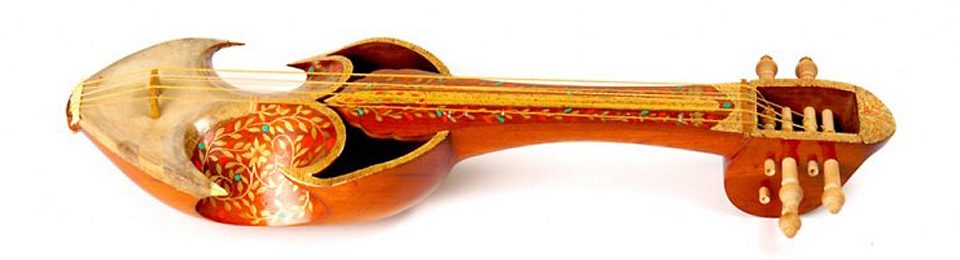
The Rabab’s sound is amazing – the two models of Ustad Basat Khan that I made years ago are nowhere near sound and resonance of this Rabab that I modeled on the Rabab of Guru Arjan Dev albeit with just a few alterations and evolutions. The gut-strings are fabulous but I did not have ready stock for strings 5 & 6, an issue which will remedied later this afternoon. I am also looking forward to meeting with classical guitarist, Maestro Andrea Ferigo who also is a renowned sitarist! I am told he has invented a modified guitar to play Indian classical music and I am eager to find out out if he would be willing to take up the pre-medieval/medieval Indian ‘guitar’.

I am not so glad with the polishing job done by Parminder Singh Bhamra – seems to have been hurriedly done – I guess he will have to finish it anew under the hot New Mexican sun…

There is one site, which attempts to compile various links and speaks of various postures and tuning modes, is as follows:
http://chandrakantha.com/articles/indian_music/seni.html

Rababs in the Market

There are a few Rabab models that have been sold around the world and are misleading the hands of innocent Gurbani Kirtan enthusiasts – one called Firandia Rabab, as claimed by the Punjabi University’s Gurmat Sangeet Department and its proponents, while the other, the Sikh Rabab (link below) as claimed by the Raj Musical Store and Raj Music Academy of London.

http://www.rajmusicals.com/product_info.php?cPath=93&products_id=1195

The following link, from the Punjabi University website, talks of the Firandia Rabab. If you see under the title “Pioneer efforts in the movement to Revive String Instruments of Gurmat Sangeet”, the statement reads “Under the leadership of Dr. Gurnam Singh, Founder Professor & Head, Gurmat Sangeet Chair, a team of scholars and musicians explored the original version of Rabab prevalent in Sikh Music…” ( The text has since been modified and the link to has changed. Here is the link to the university’s updated site: http://ggchair.punjabiuniversity.ac.in | updated at 4:07 AM, Saturday, April 17, 2021). My question is if the study was so pioneering, why are the so-called team of “scholars and musicians” not named? Where is the exploration? Was it documented? Where are the images of all the Rababs that were studied, etc. The sad fact is that this is all fiction writing – calling the model attributed to Guru Gobind Singh that is an exhibit at the Gurudwara at Mandi, (now) Himachal Pradesh is a cheap stunt. One can read the account of the department’s so called research (poor) appropriated in the monograph Rababi Mardana by Dr. Mohinder Kaur Gill. The PDF of the book can be procured from the following site (link updated at 4:08 AM, Saturday, April 17, 2021):
https://sikhbookclub.com/Book/Bhai-Mardana

In an interview with Aparna Banerji published in The Tribune, http://www.tribuneindia.com/2011/20110424/edit.htm#3, Dr. Gurnam Singh had the following to say:
“Q. What are your department’s future plans?
A. We are conducting research on stringed instruments. Particularly the Rabab. The Firandia rabab that was handed down to Bhai Mardana at Firanda is the original one. People often confuse it for the Kabuli, Afghani or the Kashmiri Rabab. We plan to bring out a dictionary of terminologies on Gurmat Sangeet and plan to launch online courses for students.”

The question again is how does he know that the Rabab what was handed down to Bhai Mardana was already called “Firandia rabab”? In her monograph, Gill quotes the brochure that the Gurmat Sangeet Department released on the day of the department’s inauguration. She quotes that Guru Gobind Singh had a Rabab made on the model of Firandia Rabab hence the model exhibit at the Gurudwara, Mandi is the Firandia Rabab. Where is the reference for all this (crap)? Lies and fiction-writings do not serve a community or a musical tradition, howsoever grandiose, in any way..!

Another baffling post of the Rabab is at the link of Raj Musical Academy:
http://www.sikhsaaj.com/rabab.html

Read the titles – it is as if it is being played by Bhai Mardana himself – speaking of semantics and precision! For more inaccuracies (rabab as the “shadow of Guru Nanak” taus and dilruba related), read the following page:
http://sikhpunjabimusic.blogspot.it/

{I posted this post on June 27 and added these links on June 28. Today, one of my students was trying to access the above link but it has since been removed..! Why don’t people who post these links without references and merely based on fiction have the scholarship to accept an error. Even if they have to remove it, they should specify the reason and if they are being forced to remove, which is not my actual intent, they should acknowledge the reason and the people because of whom they are now correcting a mistake – that will show some integrity. Fortunately, I have saved the now removed page and will find a way to post it shortly.
I have also noted that the captions on the videos on http://www.sikhsaaj.com have been removed for I had questioned these videos. Again, I have saved the original postings and will post them shortly. Academic integrity does not seem to be doing rounds these days or so it seems..!}
Furthermore, the saranda, rabab, taus and jori illustrations are flawed – the making of these instruments are very new with no history all that can happen – when the makers do not know how to make these instruments, the players do not know how to play them – is happening 🙁

(Added on July 3, at 07:13 hrs, NM time)
There is one, which I chanced upon moments ago and find more closer to the original, at the following link:
http://www.tablasitaruk.com/professional-quality-punjabi-rabab-p-80.html
There are certain issues though, which distance it from its original luthiery techniques,  tradition and history.

Debating Stringing

With Mimmo Peruffo in his office.

Sadiq Ali Khan, in his book called Laws of Music (Qanoon-e-mousiqui, 1874), says that the ancient Rabab had 4 metal (faulaad) strings while the Rabab of Guru Nanak had 6 silken-strings. When I had called upon musical instrument maker, Gurdial Singh of Jalandhar in 2008, when I was doing a documentary series – Luthiers of Punjab, in which I exposed some of the frivolous claims made by some of these instrument sellers. I had showed him the rabab that I had handcrafted for Luigi Hari Tehel Singh (15), he had asked “why six strings – aren’t four enough?” Of course, I told him that “that’s the count of strings on Ustad Basat Khan’s 300+ years-old Rabab”. Yesterday, with Mimmo Peruffo, I debated this idea of 6 strings – even if made of guts. So far, I had tried many formulas and combinations but in the end it was more or less 4+2 rather than six-in-line. One is short of ideas while imagining the kind of guts or silk strings that were then used. Whose guts were they – cat, horse, donkey, monkey, cow, buffalo, zebra, lion or tiger? How were they made (processing, etc.)? What was the tuning method, in case the playable strings were only four and the other two played more like a veena chikari (the one also copied on the sitar)? Mimmo came with an extraordinary solution for the sixth string – but we parted in awe – for how was Bhai Mardana rabab strung – was tuned – was played…?
Postcard 33: How I spent my summer vacation

24 Sunday Jun 2012

Posted by in Postcards from the Journey, Reflections

≈ Leave a comment

In one week a group of kirtan students will meet for the 16th consecutive summer to learn with Bhai Baldeep Singh, this time in Albuquerque, New Mexico.  This is how I have spent my summer vacation each year for more than a decade and a half. These summer workshops, together with the annual winter gatherings, have been the foundation of learning and have provided the tools for this current project to sing all the shabds in the two volumes of Gurbani Sangeet.

This is something I wrote one year ago after the summer kirtan gathering. It is a personal history of my kirtan journey:

The first time I heard Gurbani Kirtan it was a song that my heart knew and I wanted to learn more about this music. In those days we listened to recordings and tried to learn to sing the shabds, but inevitably we simplified the melodies, Americanized them and we could only sing what we could hear. Or sometimes we would hear things but lacked the ability to reproduce them. We learned how to sing along with harmonium and sometimes teachers would come from India. Classes were centered around learning shabds line by line with harmonium.

One day in 1975 a friend told me, “you know, the harmonium is not the original instrument for kirtan. In the old days people sang with stringed instruments.” This excited me and I tried to imagine what the music would sound like. I was sure it would be beautiful. “Where can we learn this?” I asked. No one knew.

Reading from Siri Guru Granth Sahib I wondered about the ragas given. What would this sound like in raga dhanasri, rag bilawal, sri rag? Can shabds be sung in these ragas? How do you learn ragas? There were some Americans learning Indian music and Indian instruments but the opportunity never came for me.

In the early 1990’s a Sikh moved to our town who was from the Nanaksar tradition. He knew how to sing shabds and he knew about tala and ragas. I asked him if there are melodies in ragas that match the name of the shabd and he knew some of them. He gave me the notations and taught me how to sing them. I enjoyed these shabds and wanted to understand the ragas and tala structure. Unfortunately this friend moved out of town and the learning was discontinued.

In the summer of 1996 an Italian friend, Kirti, told me about someone she had met in New Mexico. He was a Punjabi who could speak Italian and was restoring the stringed instruments that used to be used in kirtan. I hoped that I might also be able to meet this person. The following spring someone handed me a piece of paper and said “you might be interested in this.” It was a flyer announcing that Sangeet Kaur and Harbhajan Kaur were organizing a workshop in New Mexico with a teacher who was a 13th generation exponent of Sikh kirtan. He was reviving stringed instruments and would be teaching the traditional music from the guru times. “This must be the person Kirti told me about,” I thought. “This is what I have been waiting decades to learn”. I was so excited I immediately called Sangeet Kaur and signed up for the workshop.

I had no expectations for the workshop but came to learn about the old ways. From the first day I realized this would be unlike any previous experience and would require an attitude of going back to kindergarten and a willingness to start at the beginning. The knowledge shared left a hunger for more and the practice was a challenge that begged to be pursued. The final day of the class was heart-breaking as my heart feared that another feast might never come and the hunger might never be satisfied.

Bhai Baldeep had mentioned that he would like to teach an intensive 9-day workshop so the next summer I organized one. Since that time we have been meeting twice a year. The process has required much patience on the part of the teacher as well as the students. The voice instruments required a lot of cleaning to scrape off old habits and patterns and polish with the tools of naad yoga. Focus, pronunciation, and understanding were improved along with musical skills in rhythm and melody.

In 1999 I asked Bhai Baldeep if he would sing at my son’s wedding. He said “I will get my great uncle to sing.” It was a great honor to have Bhai Avtar come to New Mexico for the wedding. In the 1980’s he had visited with Yogi Bhajan and had sung in some of the American Sikh gurdwaras but it had been many years since those visits. After the wedding Bibiji invited Bhai Avtar Singh to return in August for Yogiji’s birthday celebration. Bhai Baldeep arranged for Bhai Avtar to teach during the August visit. This began regular visits by Bhai Avtar and Bhai Kultar to teach in Espanola during the annual birthday celebration. Yogi Bhajan encouraged his students to learn classical Sikh kirtan. Several students have studied with various teachers, and the sangat deepened its interest in “raga kirtan.” 

For those of us studying with Bhai Baldeep Singh, after years of imagining the sound of kirtan sung with stringed instruments, the sounds are appearing as we learn to play the instruments crafted by our teacher, jhori, taus and the voice instrument. Personally, this has been a profound and transformative journey. Most importantly it has been a meditation on the bani revealed through the Sikh gurus through the medium of music. For us, the gian travels on the waves of sound to touch the heart, still the mind and awaken the soul.

Postcard 32: The “s” word

20 Wednesday Jun 2012

Posted by in Postcards from the Journey, Reflections

≈ Leave a comment

Tags

Nirvair's blog

I’ve met alot of people who are uncomfortable with the concept of sin, like we should be able to live a spiritual life without taking a look at the self-serving, error-making tendencies in ourselves, a very real part of being human.

How can you sing the shabds in rāga jaitsri and escape the encounter with your own unworthiness, countless mistakes, ego involvement, flirtation with the five friends? The Gurus don’t hold back or speak euphemistically about the ugly side of our nature, and they are very direct with their language. The person involved in me-myself-and-I is lazy, sleepy, childlike, foolish, ignorant, sold out to maya, lustful, corrupted by 5 vices, far away from the Lord, suffering, faithless, shameless, fearful, greedy, anxious, rushing around in 10 directions, deluded, entangled, bound down, lost, and constantly making mistakes. And these are just some of the images from a few shabds in one rāga!

But the Guru doesn’t stop there. I think what people don’t like about the concept of sin is that we equate it with a focus on the guilt, shame and punishment attached to it, “you are a sinner, therefore you must suffer.” And you should feel really bad about it! The Guru’s way is different, “I am a sinner AND I am Yours!” There is always a choice. I have no virtues, all virtues are Yours. When I remember You, I am united with You, I am united with virtue. Just as the Gurus describe the frantic, suffering ego-involved state, they also describe the state of remembrance, clever, wise, enlightened, shutters open, loving every instant, empowered with life force, destiny fulfilled, sweet, blessed, protected, merciful, fearless, successful, joyful, delighted, hopeful.

On my own, anxious and in pain, chasing after this and that, sabotaging my own life, regretting the past, worried about what’s coming next. Remembering You, peace and presence in this moment, aware of the infinite capacity of the heart for love and forgiveness, for mercy and grace, seeing You instead of seeing a problem. Remembering You I see all of it without judgment or blame, accept the sinner-self that belongs to You along with the beautiful refuge of virtue You offer and in that moment of remembrance I know either is always possible, depending on where I look and how I see.

Some of the shabds confront the miserable side of self, fearlessly seeing deeply, with eyes open wide. Can a song be like a sacrament of confession? After that humbling awareness what else is there to do but sing?

Postcard 31: Life is art is life

16 Saturday Jun 2012

Posted by in Postcards from the Journey, Reflections

≈ Leave a comment

There is a certain irony being in New York City, surrounded by the marvelous creations of the human mind, much of it brilliant, plenty that is not, singing in my hotel room about the temporal nature of it all. Viewing the city from atop the Rockefeller Center it all seems here to stay, the towers taken out on 9/11 just a tiny fraction of the whole landscape. A lot of faith has been placed in granite, marble and steel. Architecture, art, music, theater,  fashion, food –humans are very creative, so many ideas to express. What is it about the artists who take their art to the bigger questions? Is that what makes the great art great? Is it the connection to life and death and here and hereafter and peace and pain and love and God? Some art, while clever and entertaining, feels shallow, while some art is actually heart wrenching and soul touching. What about the great ones who make us laugh?

The artists show us another way of looking at the world, at life, our experience, our relationships. It’s not just the piece of art that moves us, although it may be beautiful or executed with amazing technical skill. It is the artist’s experience we feel and what it evokes within ourselves, the resonance, the connection. We see the world the way they saw it, we begin to appreciate the small everyday sights and sounds differently. The artists capture a feeling we recognize or they help us understand in a way we didn’t understand before or question in a way we didn’t question before. There are countless creative innovators and inventors–painters, sculptors, philosophers, singers, photographers, composers, performers, designers, writers, teachers–the great ones move us just the same.

The artists show us life. Art matters, life matters more. The art is just what remains of the experience, and becomes a reflection of the experience the next participant brings. Is art for collecting or is art for living? Bringing the art to the life brings the art to life. Living the life is the art.

What happens when the artist is a great Guru? How do the Guru’s songs touch this 21st century life? This project could easily become a checklist to complete, but it is richer to take the songs in, apply them where they matter, imprint the vision of the artists, look at what they have shown us, seek to see the way they saw. What would the Guru artist see here now?

Postcard 30: Plastic Brains

12 Tuesday Jun 2012

Posted by in Postcards from the Journey, Reflections

≈ Leave a comment

On the plane to New Jersey for my daughter’s graduation as a new Doctor of Veterinary Medicine, I pulled the airline magazine from the seat pocket and turned to a hopeful book review for The Woman Who Changed Her Brain by Barbara Arrowsmith Young. It’s about another scientific discovery that basically confirms what the ancient wise people figured out before experiments, research and clinical trials were the standard.

This book tells the story of people with severe learning disabilities (including the author herself) who have been able to rewire their brains through consistent brain exercises. Beyond coping with their challenges or finding ways to get around obstacles, exercising the brain can actually transform the circuits, rewire the programing, create new possibilities.

This is possible because of brain plasticity. The brain isn’t rigid, set for life. It can change, it’s malleable.

To me it seems like the best encouragement for a regular practice. The mental habits that keep the eyes seeing what’s wrong, the heart shut down, the tongue engaged in trivia, the ears enticed by drama, can be transformed by daily practice. The mind, engaged in simran, like the honeybee in the flower, the eyes see the One everywhere, ears hear the Truth, the heart holds love and devotion, the tongue recites the praises.

Brain plasticity, heart elasticity, sadhana complicity, purify toxicity, crush ego centricity, dispel duplicity, gentle simplicity, serene felicity, real authenticity.

Discovering a Vikram Seth

08 Friday Jun 2012

Posted by bhaibaldeep in Postcards from the Journey

≈ 2 Comments

Photo by Nira Veer Singh

A luncheon meeting with a doctor friend at the Italian Cultural Center turned out be an interesting date. Well, first it was a pleasant surprise to meet up with Nira –in all white– who wed Veer a couple years back – she looked beautiful and her earring, sported solo on port-side, was fabulous.
Then, Nira came up to me as I was half-done with my plate, ravioli stuffed with ricotta and spinach (was too cheesy for my liking), and wondered how Vikram Seth’s brother was named. I got up, which seemed to have initially embarrassed Nira, and walked up to Vikram Seth and (after brief intro) asked him his brother’s name.
Once Vikram was done with the drinks he had ordered, he walked up – he was shorter than I would ever have imagined but walked broad with aplomb – and joined me at my table – as our musical discussion began.
It began with us sharing notes regarding various genres (including how Sufi sangeet was in medieval times) and poetic structures and similes, the advent from chantt to the refrain bearing pade singing. Our discussion then meandered towards various kinds of chantt anchoring especially on the kundaliya chantt, one of which I sang as an illustration. To my surprise, he began to sing along – quite well for a novelist as I originally thought he merely was – amazed at the introduction of a uniquely placed note after another for I sang a chantt in raga tukhari. At one time he did a marwa scale very ably and identified ragas sri, marwa, todi and multani – interestingly, these (his favorites) were all komal rikhab (flat second) clad. The way he spoke of raga todi prompted me to sing a 15th-century masterpiece of Bhagat Namdev. He said – “teach me along” – and what a joy it was to have him sing along.
Some encounter with a novelist..!

Postcard 29: Sadh Sangat

06 Wednesday Jun 2012

Posted by in Postcards from the Journey, Reflections

≈ Leave a comment

Where is Sādh Sangat? Where is the community of those who love the Lord? Where are the servants who have left ego behind? Where are the ones who meditate on the Fearless One? Where are the ones who aren’t afflicted by sorrow? Where are the ones who don’t desire anymore?

Is the Sādh Sangat people or is there only One Sādhu? Is there a place to go to be with the Sādhu or is the Sādhu here and everywhere?

If Har is within each and every heart how can we be that for each other? Is sangat where ego is gone and instead of showing that self to each other we show the One within?

Is sangat what I get out of the encounter or is sangat what I give?

It is not easy to walk on the path. How do we help each other live in remembrance? How do we help each other remain in the sanctuary without sorrow, without fear, without desire? How do we stay in the shelter of love?

Does sangat have to feel good? Or is sangat sometimes a churning, a rubbing, a polishing, a challenge as I have to see myself through the eyes of truth that may reveal something I would rather leave hidden? Is sangat always like a velvety polishing cloth or can it be rough like sandpaper? Can the sandpaper be painful? If it hurts is the sandpaper to blame?

How many people is sangat? Can sangat be one? How about two? How about me and you?

A Word.

05 Tuesday Jun 2012

Posted by bhaibaldeep in ANAD Poetry Page

≈ Leave a comment

Words are like waves.
A word is, in fact, the content of a wave.
Each wave is seeped, and content, in its content.

The moment a thought arises, it begins to flow as a wave, until it merges into eternity. Where the destination is none other than the point of origin but which is transformed solely for the memory of the journey of the wave.

I am a mere witness, of the countless waves that flow by, frozen in awe, on the bank of the aab,
atop a mound of fleeting sand.
But, I have only seen my words drown – I can’t explain why –
perhaps were they burdensome – empty?

Wahu! A moment when a wave was born, a wave that then rode atop the waves that flow on from times – the witnesses – before. My eyes follow it, my being filled with joy inexpressible – so infinite!
Infinite? Then, melancholy set in as the wave was lost to the horizon.

I am only a moment – a mere fleeting moment but have found (my) arth – the meaning of being.
That I flow on in the intent of the word that rode aloft – as if in prayer – as if in hope.

← Older posts

Subscribe

  • Entries (RSS)
  • Comments (RSS)

Archives

  • May 2026
  • December 2025
  • May 2025
  • December 2024
  • June 2024
  • January 2024
  • November 2023
  • May 2023
  • January 2023
  • May 2022
  • December 2020
  • July 2020
  • April 2020
  • December 2019
  • January 2019
  • November 2018
  • June 2018
  • March 2017
  • December 2016
  • August 2016
  • June 2016
  • February 2016
  • October 2015
  • September 2015
  • August 2015
  • July 2015
  • June 2015
  • May 2015
  • April 2015
  • March 2015
  • November 2014
  • October 2014
  • September 2014
  • August 2014
  • June 2014
  • May 2014
  • April 2014
  • March 2014
  • February 2014
  • January 2014
  • December 2013
  • November 2013
  • October 2013
  • September 2013
  • August 2013
  • July 2013
  • June 2013
  • May 2013
  • April 2013
  • March 2013
  • February 2013
  • January 2013
  • December 2012
  • November 2012
  • October 2012
  • September 2012
  • August 2012
  • July 2012
  • June 2012
  • May 2012
  • April 2012
  • March 2012
  • February 2012
  • January 2012
  • December 2011
  • November 2011
  • October 2011

Categories

  • ANAD Discussion Forum
  • ANAD Events
  • ANAD Foundation
  • Anad Initiatives
  • ANAD Khand
  • Anad Lecture Series
  • Anad Luthiery
  • ANAD Obituaries
  • ANAD Poetry Page
  • Anad Residencies
  • Anad Scientific Advisory Committee (ASAC)
  • Enroute to a realisation
  • Guru Nanak Dev University Events
  • Humour & …
  • Lines and Colours
  • Mere Music
  • Oral History Archives
  • People
  • Photos
  • Press
  • Quotes
  • Ravneet Sangha Anecdotes
  • Reflections
    • Postcards from the Journey
  • Responses
  • Rāngli Sath
  • Sarcasm
  • Television
  • Uncategorized

Meta

  • Log in

Culture | Conservation | Continuity

Create a website or blog at WordPress.com Theme: Chateau by Ignacio Ricci.

Loading Comments...