
A report by Narinder Sonia carried in Punjabi verncaular, Daily Ajit.
27 Wednesday Feb 2013
Posted in ANAD Foundation, Press
A report by Narinder Sonia carried in Punjabi verncaular, Daily Ajit.
26 Tuesday Feb 2013
Posted in Humour & ..., People, Postcards from the Journey
On February 18, 2013, I spent wonderful 3 late night hours discussing, debating, conversing, laughing, reminiscing with Bhai Balbir Singh Ragi at his lavish residence in Amritsar. Clarified a lot of ‘histories’ with him and shared a lot of information with him.
Bhai Balbir Singh and I, we have had an interesting relationship spanning over two decades now. I will never forget the first time we met in Chandigarh and told him that I am the grandnephew of Bhai Gurcharan Singh Bhai Avtar Singh – he had very lovingly embraced me then. His two brothers, Bhai Mohinder Singh and Bhai Chatar Singh, loved me more perhaps? I am still unsure —theirs was a sarcasm-less attendance to ‘me’ as compared though things are looking better these days. Thereon it was an inquisitive me, by and by learning about their music – what and how they played and what and how they sang. That they had also learnt a lot from Bhai Arjan Singh Tarangar further cemented my relationship with them – I was their – and even my granduncles’ – youngest classmate.
Learning from them – Bhai Balbir Singh and his percussionist brother, Bhai Mohinder Singh – was a funny experience too. One brother would share a composition but would do so with a caveat – “please do not tell my brother that I taught you this – else he will fight with me for sharing this with you..!” Both of them taught the same repertoire hiding from each other and obviously I had two separate diaries albeit with the same compositions – talk reiteration!
There were issues which somehow soured our relation for long stretches of time. The main being his effort to claim me as his exclusive student. It seemed that he just couldn’t really get, until recently perhaps, that I am a book as if, co-authored by 6 maestros with small or relatively bigger contributions additionally from him plus 20 other elders; and that I will always cherish and also represent their treasures – their memories, including that of him.
There was a lot that most of these elders took from me as well – it was not a one way traffic. Even the fact that I was being simultaneously hopping from one maestro to another like a bumble-bee, pollinating all who I met in my strides. In the early till mid-90s, even Fahim Sahib (fondly called Papa Saheb by me) would quote me in his interviews by adding , “jaise ki, bakaul mere bete ke…” (like, just as my son (baldeep) says…). A few years down the line, the quotes remained but the reference to me had gone. But that is alright. This problem is rampant in music where the references are lost especially when all memory is not imbibed by subsequent generations.
It used to be quite embarrassing in the early years for the three brothers dealt with me as if they were dealing with my great-granduncle, Baba Jwala Singh, for they believed that I was none else but his reincarnation. Another group of people thought I was an incarnation of another maestro extraordinaire, Bhai Sahib Bhai Batan Singh of Mehli. Well, the upside was that they shared the riches they imbibed from either (and more) of these maestros, thinking they were returning back all that ‘I’ had entrusted to them before ‘I had died the last time around’. The other astonishing moments I used to be confronted with in the 90’s was when many of these ‘teachers’ of mine desired to be reborn as my ‘sons’ leaving me wondering how many would I have to father and feed 🙂 Well, they all enriched me and I am only grateful to each one of them with all my might and more.
Bhai Balbir Singh had been playing strange over the last years for he would try to deny interviews to most people I sent to him including Nirinjan Kaur Khalsa, who is doing her doctoral studies at the University of Michigen. Each time I had to call and convince him – try to sensitize him of the importance of meeting the researchers and scholars for the sake of these people gaining understanding of the tradition of Gurbani Kirtan. He would eventually relent.
No images were taken this evening – one for he was very casually dressed and the other, both mine and my student, Jatinder Singh’s phones on record modes respectively. I am sharing some images with Bhai Sahib though, from my visit to Nishan-e-Sikhi at Khadur Sahib at the invite of Baba Seva Singh Ji. The former Jathedar of Akal Takhat, Gyani Joginder Singh Vedanti was also present. I will always be grateful to Bhai Balbir Singh for his gracious comments that day.

Bhai Balbir Singh sat intimately at the edge of the stage.

He was poking at times leading to a very spiced up exchange between him and I 😉

Together we have laughed so much in the last 23 years of knowing of each others’ existence far out-litre-ing our fights..!

I am grateful for each step we are yet to stride together —each scowl – each laugh – each debate and reasoning – begging to differ or in agreement. None of it will ever matter for he is once an elder, always an elder. I can only be proud of him..!
Myths Are Thus Created
I
It was in the year 1992, that late Dr. Jolly came up to me and asked me “how can Bhai Balbir Singh say that his ancestors go back to the times of Guru Arjan Dev for he claims to be the 7th generation in his family but that would make 210 years including him (30 years multiplied by 7)? How come his ancestor was there to sing when the Rababi’s Bhai Satta Bhai Balwanda left the fifth Guru?” I had told. “let me go to Bhai Saheb and ask?” Chacha Bhai Balbir Singh had naughtily replied, “Haha! they were ‘our’ ancestors only..!”
I wonder if Dr. Jolly ever updated his writeup. If he did, that would have been scholarly but if he did not, an unfortunate myth may have been created. Sadly, Dr. Jolly died in a road accident a few years later. In any case, he should have been more academic in noting such unsubstantiated claims without subjecting them to even the simplest of scrutiny.
People would have read and believed this ‘innocent’ claim. These people would have then connected with Bhai Balbir Singh on the basis of that claim.
II
This Gurmat Sangeet Department at Patiala has been an interesting or rather an intriguing presence. The protagonist is Gurnam Singh who is very jittery, I have learnt, with my presence in the Guru Nanak Dev University, Amritsar, as a visiting professor. Some dilruba players at the Darbar Sahib (Golden Temple) have questioned my presence with “what is Baldeep Singh doing here in the university, Dr. Gurnam Singh has already done all the work in the field (of Gurmat Sangeet)!”
I have had problems with this group of individuals from the very beginning and when this story of asking the sons and daughters of some of the Gurbani Kirtan exponents of the 20th century for sponsoring rooms and auditoriums in the name of their ancestors was the lowest point they could stoop to. Gurnam sold the idea to Bhai Avtar Singh Ragi, a granduncle of mine, to pay up 25 lakhs or 2.5 million rupees (about 50,000 $s) in order to have the auditorium named in his father, the legendary Bhai Sahib Bhai Jwala Singh. It was like asking Mahatma Gandhi, “Gandhi Ji, the country would really love to make Raj Ghat (mausoleum) in your name but you will need to pay for it..!” He would have smiled and declined and so would have Baba Jwala Singh. He did not even allow his body to be cremated for people wanted to build a mausoleum in his memory after cremating his body. He ordered his sons and nephews to quietly offer his body to River Beas so that none of his ‘followers’ would know the place of his bodily burial. When my grandaunt Bibi Amar Kaur, wife of Bhai Avtar Singh, died and we were driving to Goindwal Sahib with her ashes that my granduncle showed me the place where his illustrious father’s body had been Beas-buried.
The other ridicule in the name of music which has been done is by this allocation of the term ‘Taksal’. Somehow, Gurnam has taken upon himself the role of the ordaining people and mere music schools as ‘exponents’ and ‘Taksals’ respectively. There can be no better example of this department ordaining Bhai Balbir Singh as not only belonging to but being the head of the Tarn Taran ‘Taksal’. The uniqueness being the ending pauri and singing of Dasam Bani texts. The funny side is that anyone versed with the actual tradition of Gurubani Kirtan will tell that these virtues were that of each family or school not necessarily particular to anyone particular.
While helping filling out Bhai Balbir Singh’s response form for the coveted National Sangeet Natak Akademi award, which the honorable professor (gurnam) has aspired for since the last many years, this issue of Gharana or tradition/taksal did come up.
Myths are thus destroyed
I
On the birth anniversary of the fourth Sikh Guru, Sri Guru Ramdas (Nanak IV), which is celebrated inside the Manji Sahib hall. This hall has a horrible audio ambiance, nevertheless. For the first time, I ended up being invited at this Gurbani Kirtan festival in which only the Bani or compositions by Nanak IV is sung. Bhai Balbir Singh was also one of the singers. I was scheduled to sing at the last while Bhai Sahib sang at the prime time, when the live telecast is relayed across the satellite world and venue is jam-packed. He reiterated the ‘story’ of how the ‘forsaken’ Rababi-s, Bhai Satta Bhai Balwanda had left the fifth guru, Sri Guru Arjan Dev (Nanak V), and that ‘his ancestors’ had sung the Kirtan with folk music instruments.
I had sung an original composition of Nanak IV in Raga Nat Narayan and then I had spoken in response to the claims (Bhai Balbir Singh):
One, that the historians believe that the episode of the legendary Rababi’s actually happened during the second guru, Guru Angad Dev (Nanak II) and not in the times of Nanak V. They (the historians) rely on the fact that in the ode in Ramkali by the two Rababi’s, which is included in Gurbani, the majority of the text is in honour of Nanak II, Guru Angad Dev.There was this episode of the two Rababi maestro-Kirtaniye having left the Guru’s court in a huff but had eventually realized their own error and had eventually sought forgiveness. The story of their return back to the Guru’s court is seeped in humility, grace and dignity. They are two among the other authors of Gurubani we the Sikhs, bow to in reverence. So, when the two exponents, namely, Bhai Balwand and Bhai Satta, may never have left the court of Nanak V, how could the story of anyone picking up ‘folk instruments’ be accurate.
Two, if we are to believe the legendary Bhai Gurdas, the maternal uncle of Nanak V, whose odes are equally revered in the Sikh thought, when he bears ‘witness’ (in quotes for he was not actually a witness to Guru Nanak but relied on accounts from Sikhs or Nanak-panthis associated with the first guru) that each Sikh household during the first guru’s times had become an abode of Dharma (Dharmsaal) and that instruments mridang and rabab were played. Now, these instruments are not folk instruments and require considerable learning. The music of the later gurus until Nanak V was of the highest order. Just because the Gurus’ Rababi-s used to lead the singing during the main ceremonies, it would be inaccurate to imply or infer that the Sikhs who remained when the Rababi’s left, were musically illiterate.
I also shared these thoughts with my respected ‘Chacha’ BHai Balbir Singh and I think he got his historic facts and values right.
II
While filling up the form, I asked him about the samprada or gharana (school) he belonged. His answer was Gwalior gharana for he had studied from Pandit Krishna Rao.
I asked him, “what about Agra gharana?”
He said, “No!”
I then reminded him about his learning from my cousin, Sardar Balbir Singh Kalsi and his teacher, Padma Shri, Sardar Sohan Singh who was a disciple of Ustad Faiyyaz Khan of the Agra gharana.
He exclaimed, “But he (Ustad Faiyyaz Khan) lived in Baroda!”
I clarified, “Yes he was the court musician in Baroda (the Royal court of the Gaekwads) but his gharana is called Agra gharana.”
With a “Sure, then add that!” Bhai Balbir Singh had nodded.
I then asked him about the Gurbani Kirtan repertoire of his. He said “We have our own gharana, of Tarn Taran” referring to the status ordained by the Department of Gurmat Sangeet, Punjabi University, Patiala.
I asked him, “Who was your teacher?”
He said, “Pandit Nathu Ram”
I asked him, “Who was Pandit Nathu Ram’s teacher?”
He said, “I do not know!”
I asked him details about Pandit Nathu Ram’s singing style who was an extraordinary Dhrupad singer. He only remembered about the “makaaN lagaanaa” but no composition. I did correct the pronunciation of his for he was calling it mukaam but did not tell the name of Pandit Nathu Ram’s teacher, who was a junior classmate of Baba Jwala Singh, a great-granduncle of mine.
So many people taught at Tarn Taran and the most important exponents to teach there belonged to the same tradition and lineages as my own. To term it now as a Taksal or a gharana is nothing less than a cruel joke on the tradition.
12 Tuesday Feb 2013
Posted in ANAD Khand, Photos
Friends, I am merely talking of framing paintings! Hari Om Lal runs a massive enterprise called Sharma Framing House at Okhla Industrial Area, New Delhi. He has been the favoured framer for artists like M F Hussain, Krishen Khanna, Swaminathan, Manjit Bawa, Paramjit Singh, Sidharth and now also for Hardev Singh.
Artist Hardev Singh is Anad Conservatory’s first artist-in-residence. Since October 1, 2012, he has been stationed inside the Sultanpur Lodhi Fort, the site of the conservatory. His stay has been mired with some difficulty – with the Station Head Officer (SHO) forcibly opening up the gate to allow visitors to pass through, totally disturbing the serene and artistic environs around Hardev Singh’s workplace. It is always an issue when people who are supposed to serve and facilitate try to pretend as masters. The SHO is such a fine man otherwise who loves animals and his drinks. I was very sad that he had tried to intimidate Anad Foundation’s local staff – an issue which I will be addressing with him in the next days. Nevertheless, Hardev Singh has painted a lot and I drove to Delhi with 57 paintings done by him at the fort – in water colour, oils and sketches..! Packing and then carrying them all in the Toyota Innova was quite an ordeal though.
Nearly 45000 Rs (about 800 $s) stood wasted for 37 paintings were framed by a local carpenter who really botched it all up for he had never done framing before. Windows are like frames, for the world sees you in it and you the world outside, but they aren’t frames. My staff at the fort only informed me when the wood had been bought, and cut. The mounts, the best that were found in Jalandhar city, were shiny hence pathetic. The end result seemed like a great singer entrapped in the midst of ordinary accompanists!
Yesterday afternoon, that is on Monday, February 11, 2013, I went to Sharma Framing House and requested Sujit, the younger brother of Hari Lal, to do a sample frame with an off-white mount. The traffic was much and I remembered Pasquale, a brother-in-law, teaching me in the summer of 1995 to exclaim “Ma, che traffico!” in Napolitan when caught in such a situation. You can try it as well but the traffic remains. At about 7p, I walked to the waiting car and drove with a brownish frame clad Raga Vadhan painting as the difference showed – aesthetically and weight-wise. The glass was a mere 2mm instead of the 4mm they used in Sultanpur Lodhi. The Italian wood used nowadays by Sharma Framing is very light in comparison to the Kail wood used by the local carpenter, which was much heavier also for it yet retains much moisture. Expect the Kail wood frames to warp this summer. I thought, as I waited for my turn to pass the traffic lights at Ashram Chownk, to try and securely pack the Kail frames in fives to limit their warping. Once home, I got to confer with Maurizia, with Paolo Pacciola and his danseuse wife, Luisa Spagna, joining in with their suggestions. They all voted for the new frames, but they aren’t cheap.
Picking up Artist Hardev Singh from the station was an ordeal too. We took nearly an hour to find him! He didn’t wait for Parminder at the platform but started walking towards the ‘gate’. He asked a lady for the exit – she pointed to the Ajmeri Gate side – we were were searching for him on the Paharganj side as planned. It was proving impossible to speak to him over the phone for the noise. After the search operation had run for three quarters of an hour, I asked Parminder to go looking on the other side and that’s where he was. How he had thought there was only one exit! Parminder and the Artist eventually took an auto-rickshaw for it would have been an ask for him to walk all the way to the Paharganj side! Once home we spent sometime reviewing the two framing options. Hardev Singh liked the new frame. Although he was reluctant to do the new frames for the added cost burden on Anad Foundation but the qualitative difference was huge. Moreover, the carpenter had used some poor quality plywood on the rear-side of the frame which can become termite infested damaging the paintings.
Here are some images from the visit to the framing place:

First stage when the frames get cleaned up and sanded.

Stage 2 when the wooden stock is colour dyed or varnished.

Stage 3 when the artisan make the mount – we had chosen an off-white coloured mount.

Stage 4 when the artisan measures the mounted painting and calculates the size of the frame.

Stage 5: Frame lengths being cut.

Stage 6: Glue is applied

Stage 7: Staples

Stage 7: Staples II

Stage 7: Staples III

Stage 7: Frame and mounted painting readied for the glass mounting.

Stage 8: Glass cut I

Stage 8: Glass cut II

Stage 8: Glass cut III – cleaning

Stage 8: Glass cut IV

Stage 8: Glass cut V

Stage 8: Glass cut VI – cello tape secures the mount with the glass

Stage 8: Glass cut VII – final check before fastening the rear panel
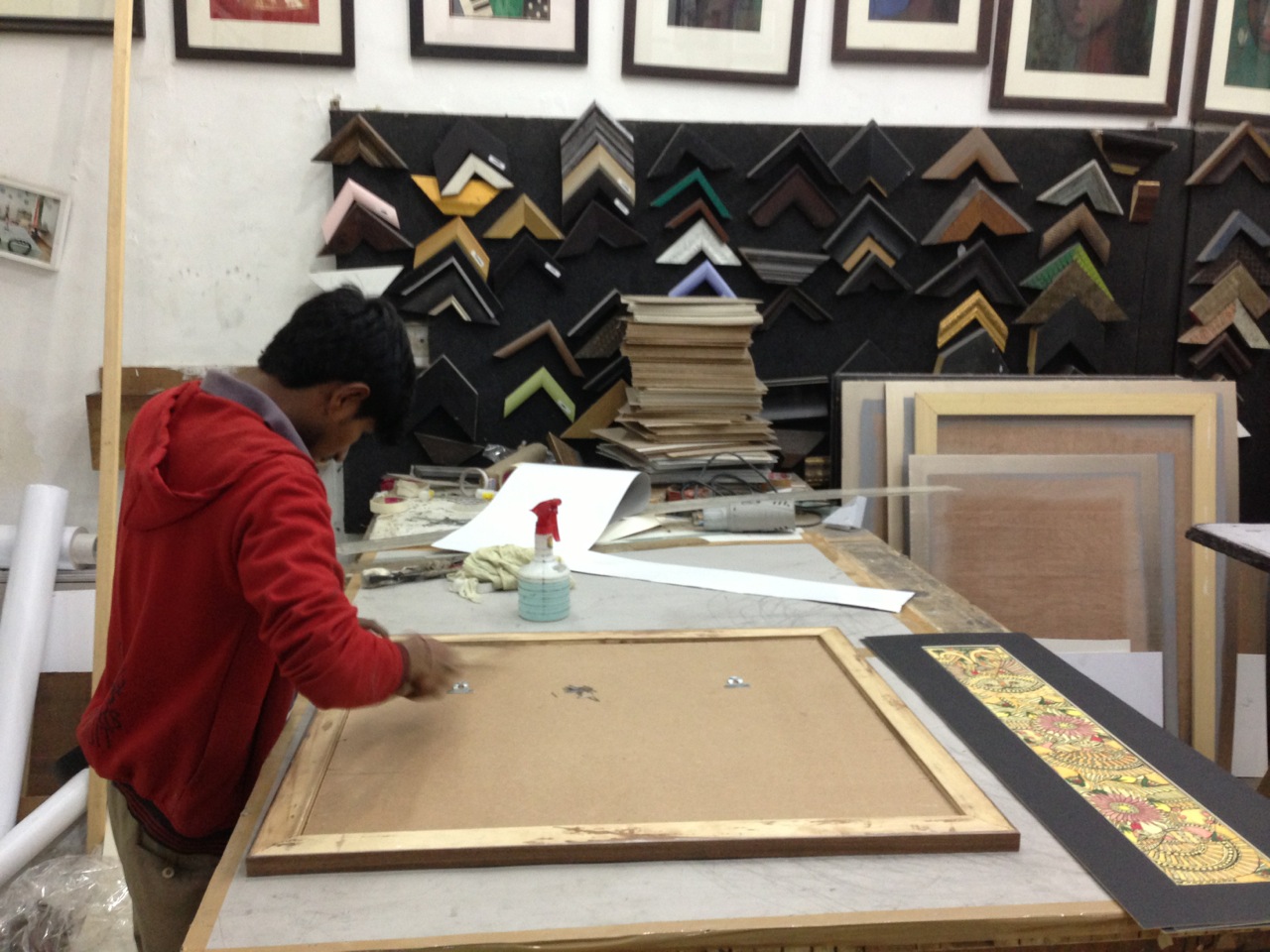
Stage 8: Glass cut VIII – Rear panel being fastened

Stage IX: Final touches.


and Pronto..!
08 Friday Feb 2013
Posted in ANAD Obituaries, ANAD Poetry Page
Touch phones can be touching too...
Ma hasn’t called me since
the day before she breathed
her last – by ‘mistake’
I dialed her number…
I didn’t wait for her to
answer this time
Not because I didn’t expect
her to answer my call, rather for
What would I say if she asked
‘Son, what took you so long to call me since..!
I only breathed my last then
But I haven’t stopped
breathing since.!’
My Eyes had
a torn tear each
One churned by
My heart
The other
By my soul…
She was always a part of my journeys
Before I embarked upon, or
upon my returns
I would call her
It seems as if she
tele-ported herself to
wherever I was
to care for me
or just to be there
for me.
Now, all I have of
her is me.
She now lives with all the mothers
and fathers of the bloodlines
that run in my veins.
Each of those mothers and fathers have a task
Some specialize in cardio, others
neuro, ortho, and so on.
Sometimes they all work in silence
but most times they sing.
—always encouraging
—inspiring
—praying but,
never condoling for
there isn’t any reason for
there isn’t any dying
there hasn’t ever been a death.
The 1 life that Is.
06 Wednesday Feb 2013
Posted in ANAD Khand, Press

A report in Daily Ajit by Narinder Singh Sonia. February 4, 2013.
03 Sunday Feb 2013
Posted in People, Photos, Postcards from the Journey, Reflections
A few months ago, I finally got a professional scanner with an aim to scan thousands of negatives, transparencies and prints that had been lying around unattended. Two of Anad’s volunteers, Akshay Sharma – a neighbourhood kid, and a computer engineer with serious photography interests, Gurliv Singh, a nephew, had very kindly accepted to do the ‘job’. Every now and then, my heart quivers at ‘re-discovering’ and perhaps in some way, revisiting, moments of my life when I had the privilege of being mentored and tutored by some of the finest ‘farmers’ of the 20th century South-Asia.
Maharaj Bir Singh, the younger brother of the Maharaj Jagjit Singh (1920-2012) by two years, the previous head of the Namdhari Sikh Darbar, Bhaini Sahib, was an extraordinary – a beautiful man —what a mentor – what a philanthropist..!
As he introduced me once to some of the Haryana State political top brass and aides of a certain political party, who had to wait for two extra hours because he and I, were singing and playing on the second floor: “Do not be fooled by his humble appearance – by his loosely tied turban, kurta and kashehra“, he had surprisingly said, “he does photography – so did I, he did flying – so did I, he plays pakhawaj – so do I, he sings dhrupad – so do I..!” One of those present was the young and promising Kumari Shelja, who has since served as Cabinet Minister, Government of India.
He was as if humility, compassion, love and generosity incarnate. For a few years, the first stop he would make after reaching Nizamuddin Rail station from Bangalore, where he would be visiting his son, would be at my Nizamuddin residence – be it any hour of the day or night. We would take turns – playing pakhawaj, singing, playing dilruba. Sometimes, he would recall a few compositions and teach them (as in image-I, below). He would sometimes write a letter with notated down compositions – saying I learnt this from so-and-so ancestor of yours or from another maestro.
Reviewing some of the recent scans the two volunteers at Anad have recently done – I found these images (Photos by Maria Maurizia Costanzo from January 1997), which I share as I eagerly await for more, and more…

I remember learning the Be-aaR composition from him. Most probably, January 1997.

Singing compositions that he learnt from Bhai Kaloo, the Rababi exponent from Anandpur Sahib.

‘That look’ as I would await his next sudden-strike – he was a very naughty warrior-musician..!
Shortly after, I visited him at his place in Jeevan Nagar, District Sirsa, en route to Ganganagar where lived Bhai Ratan Singh from our village. Those years, I traveled with my cameras, instruments, a/v recorders all loaded (in the station-wagon).
The evening session we had, past dusk, is etched in my memory – perhaps my finest raga sri rendition till then, with Maharaj Bir Singh playing some scintillating stuff on the pakhawaj —was perhaps one of those times when, under the stars and skies, just about everything clicks. He also played some dilruba that evening with the honour to accompany him on the Jori all mine. Here is an image I took as he played:

01 Friday Feb 2013
Posted in ANAD Khand, People, Photos
While driving towards Sultanpur Lodhi, I saw Professor Kartar Singh on the highway waiting for a bus just past town Khmano on Chandigarh-Ludhiana highway. I had to make an abrupt stop and reverse the old lady Innova in order to block the bus which was about to be driven away. I got him off the bus for he had already climbed inside and was looking for a place to sit. I was half worried with an eye on my vehicle to make sure nobody ran away with it, as we see sometimes in the movies – motor vehicles of all kinds being ripped off leaking folks.
We were soon belted and rolling at 75mph. Instead of Ludhiana, at about 4:40 PM, seated inside the Qila, Sultanpur Lodhi – the site of the Anad Conservatory, I was interviewing him with some of the local press reporters also joining in. During the conversation, while telling him that I do not know what this ‘light music’ actually means, I demonstrated a composition in a ‘small’ rhythmic cycle, which was mostly centered magically on one note only. Since, I understood the value of this composition, singing hadn’t been the same. One can have an extraordinary composition but singing less than extraordinarily or singing an ordinary composition extraordinarily..!
He is a fine man and one of the finest contemporary composers in India. Already a recipient of the National Academy of Music, Dance and Drama (Sangeet Natak Akademi)’s Akademi award (2008), he, alongside Bhai Sahib Bhai Gurcharan Singh and Maharaj Baba Jagjit Singh Ji, was made the Tagore Fellow of the Akademi.
As usual, the huge parrots provided background songs. Here are some images taken by Jatinder Singh Bhamra using my little Leica:


