• About The Anād Foundation
    • Aims & Objectives
    • Governance
      • Board of Advisors 2026-2029
      • ASHA 2026–2029
    • Trustees & Associates
    • Historical Records
      • Founder Trustees
        • Bhāī Baldeep Singh
          • First visit to the Qila
        • Chiranjiv Singh
        • K. T. S. Tulsi
        • Kiranjit Singh Bawa
        • Manjit Kirpal Singh
        • Pervinder Singh Chandhok
        • Raj M. S. Liberhan
        • Ranjodh Singh
        • Ravinder Singh Ahuja
      • Board of Advisors
        • Rear Admiral Kirpal Singh, AVSM
        • Major H. P. S. Ahluwalia
      • Associate Trustees 2008-2011
      • Associate Trustees 2011-2014
      • Associate Trustees 2014-2017
        • Mayank Singh Bawa
      • Associate Trustees 2017-2020
      • Associate Trustees 2020-2023
    • Team & Project Associates
    • Financial Highlights — Archival Record
  • Anād Khaṅḍ / Conservatory
    • Anād Khaṅḍ — The Proposal
    • The Institute
      • Faculty
        • Resident Faculty
        • Visiting Faculty
      • Learning Streams
        • Class With Bhāī Baldeep Singh
        • After-School Studies
          • AAS Study Programme Coordination Committee Meeting I & II
      • Workshops
        • Gurbāṇī Saṅgīt Workshops
          • With Bhai Gurcharan Singh
          • With Bhai Baldeep Singh
            • BBS I
          • With Ustad Harbhajan Singh Namdhari
        • Dance Workshops
          • Kathak with Maria Maurizia Costanzo
            • Maurizia’s Workshop Note
            • Gallery
          • Chhau Dance with Luisa Spagna
            • A Note by Luisa Spagna
        • Theatre Workshops
          • With Kuljeet Singh
            • Theatre in the spaces
            • Gallery
        • Photography
      • Outreach
        • 2018: Poznań, Poland
        • 2019: Poznań, Poland
        • 2025: Rovigo, Italy
      • Gallery
    • ANĀD Scientific Advisory Committee 2009-2017
      • First Thoughts
        • By Professor Paolo Ceccarelli
        • By Professor Rabindra Vasavada
        • By Ashok B Lall
    • Costs and Funding Framework
    • Luthiery School
      • Rabāb
        • Harbhajan Kaur’s Rabab
      • Saranda
      • Taus
    • Audio-Visual Restoration Studio
  • Gurū Gaurav 350
    • Guru Gobind Singh — A Prophet With Difference
    • Gurū Gaurav — A Concept Note
    • Gurū Gaurav — Press Release
    • Performers
      • Rânsubāi
        • Inauguration
        • Raghuvir Mallik
        • Sangeet Kumar Pathak
        • Bibi Ashupreet Kaur
        • Ashutosh Upadhyay
        • Dr. Alankar Singh
        • Vidushi Jyoti Hegde
        • Bhai Baldeep Singh
        • Pandit Ram Kumar Mallick
        • Bhai Balbir Singh Ragi
        • Bhai Baldeep Singh —Poetry Reading
        • Pandit Rajendra Gangani
        • Pandit Yashpaul
        • Mohan Shyam Sharma
        • Jagat Narayan Pathak
        • Nihal Singh
        • Indra Kishore Mishra
        • Dr. Anil Chaudhary
      • January 1, 2017
        • Guru Gaurav Event Hosts
        • Introductions
        • Pandit Ravi Shankar Upadhyay
        • Dr. Ajit Pradhan
        • Dr. Nirinjan Kaur Khalsa
        • Ustad Asheesh Khan
        • Poet Kulwant Singh Grewal
        • Bhai Baljit Singh Namdhari
      • January 2, 2017
        • Dhaddi Desraj Lachkani
        • Poet Jaswant Singh Zafar
        • Parminder Singh Bhamra
        • Manu Seen
        • Shekhar Sen
        • Pandit Prem Kumar Mallick
      • January 3, 2017
        • Nashir Naqvi
        • Pandit Uday Kumar Mallick
        • Baha’ud’din Dagar
        • Vidushi Gopika Varma
        • Pandit Vinod Pathak
        • Jasbir Jassi
      • January 4, 2017
        • Pandit Ram Prakash Misra
        • Manganiārs
        • Samiran Sanyal
        • Dr. Gurinder Harnam Singh
        • Sukhwinder Amrit
        • Suvir Misra
        • Dr. Madan Gopal Singh
      • January 5, 2017
        • Jago Tareenjan Group
        • Dr. Francesca Cassio
        • Ustad Daud Khan Sadozai
        • Songs of the Khalsa
        • Dr. Ritwik Sanyal
        • Dr. Umayalpuram Sivaraman
        • Dr. Surjit Patar
        • Bhai Baldeep Singh —Gurbāni Pade
    • Review II by Professor Gajendra Narayan Singh
    • Production Team
  • Heritage Conservation
    • Intangible Heritage — Sūkham Virsā
      • Luthiery Tradition
    • Tangible Heritage — Sthūl Virsā
      • Qila Sultanpur Lodhi
        • Lahore Gate
          • Heritage Hammered by IP Singh
        • Darbar Hall
        • Old Kacchehri (Colonial structure)
        • Delhi Gate
        • Mosque
        • Qila Walls
    • Technology Partners
  • Punj-Care Initiatives
  • Events
    • Full Moon Events
      • May 2011
        • 6th Kāv Tarang Review
      • September 2011
        • Gallery
      • February 2012
      • October 2012
        • October 2012 Punya Baithak Gallery
        • 2012 10 29 Punyā Baithak Press Reviews
    • Poetry Festivals
      • 7th Anād Kāv Tarañg
    • Theatre
      • Story-telling by VK
    • Archives
    • Laya Darshan: Revealing the Riches of Indian Rhythm
    • Jashan 2006
    • 2008 Dharati Suhāvī
    • 2013 Harī Rāgu Gāthā: 31-Rāgu in Gurbāṇī
    • 2014 Hari Rāgu Gāthā: Singing of 31 Rāg in Gurbāṇī
    • Jashan 1915-2015
    • Gurū Nānak Dēv 550th
    • Virtual Vaisākhī 2020
    • 2020 Rai Radio3 — Dharati Suhāvī
    • 2020 Expressions on Nature: Dharati Suhāvī
  • Anād Awards
    • Award Jury
    • Anād Sanmān
      • Jashan 2006
        • Jashan 2006 Review
    • Kāv Sanmān
      • 2008
        • 2008 Review
      • 2009
        • 2009 Review
      • 2010
        • 2010 Review
      • 2011
  • Study at Anād
    • Gurbāṇī Saṅgīt Retreats
      • Retreat 61: Sikh Academy, Surrey, BC
        • Retreat 61: Ṭīkā Tipada Rāgu Mēgh
        • Retreat 61: Bilāvalu Ṭīkā — ‘Aman’
        • Retreat 61: Bilāvalu Ṭīkā — Sūlfākh & Ḍhāī
        • Retreat 61: Dhurpadā — Rāgu Sāraṅg
        • Retreat 61: Kaliān Sargam — SRG & GMP
        • Retreat 61: Rāgu Ṭikā Śuddh Malār Kul-mitra
        • Retreat 61: Rāgu Sūhī Ṭīkā
        • Retreat 61: Rāgu Sārag Āo Jāo
        • Retreat 61: Rāgu Śuddh Malār Tadra Dānī
        • Retreat 61: Āsāvarī Ṭīkā — Sūltāl
      • Retreat 25: Merced, California January 2010
        • Gallery
      • Retreat 26: London, Ontario
      • Retreat 27: Tucson Arizona January 2011
        • Love Poem
        • Gallery
      • Retreat 28: Espanola, New Mexico, July 2011
        • Amrita Kaur Khalsa
        • Gurkaran Singh
        • Guru Mander Kaur
        • Gurumukh Singh CPA
        • Harbhajan Kaur Khalsa
        • Keerat Kaur Chahal
        • Nihal Singh
        • Nirvair Kaur
        • Raviraj Singh
        • Siri Sevak Kaur Khalsa
        • Gallery
      • Retreat 29: London, Ontario 2011-12
        • Student Reviews
          • Keerat Kaur I
          • Keerat Kaur II
          • Baljinder Singh Bassi I
          • Baljinder Singh Bassi II
          • Baljinder Singh Bassi III
          • Tanvir Singh Suri I
          • Tanvir Singh Suri II
          • Harkamal Singh I
          • Raviraj Singh I
      • Retreat 30: Qila, Sultanpur Lodhi 2012
        • Concert inside Kapurthala’s Modern Reform Centre, February 18, 2012
        • Mid-term Review by Nirvair Kaur
        • Review by Nadar Nihal Singh
      • Retreat 31: Albuquerque, NM
        • Nirvair Kaur’s Review: 31st Albuquerque Summer Kirtan Course
        • Keerat Kaur’s 31st Summer Retreat Review
      • Retreat 32: Mississuaga, Ontario
        • Keerat Kaur’s Course Review
      • Retreat 40: Albuquerque, New Mexico
        • Gurbani Sangeet Retreat Review: Nihal Singh
      • Retreat 42: Rajgir, Bihar
      • Retreat 48th: New Delhi
      • Retreat 51: Online from Anād HQ
      • Retreat 52: Online from Anād Foundation HQ
      • Retreat 53: Rochester, MN
        • Rochester Preview & Screenshots
      • Retreat 54: Seattle, WA
      • Retreat 55: Seattle, WA
      • Retreat 56: San Francisco, California
      • Retreat 57: Surrey, BC
      • Retreat 58: San Francisco, California
      • Retreat 59: Khalsa Centre, Canada
      • Retreat 60: San Francisco, California
    • Anād Online
      • Anād 31
        • 4. Rāgu Āsā
          • ‘Sō Daru’ Rāgu Āsā Jaitāl — Satināmu Sirī Vāhigurū Sāhib Jī
        • 24. Rāgu Bhairau Sūrtāl
      • Anād Online Classes Log
    • Internship Programmes
      • Vasant Valley School Class XI 3-week Internship 2012
        • Chairman’s letter to Vasant Valley School Internship Students
        • Delhi Head Office – Tentative Schedule
        • Student Reviews
          • Anmol Handa
          • Himmat Singh Guram
          • Kavya Rai
          • Luigi Hari Tehel Singh
          • Uday Talwar
          • Wanhee Ji
        • Vasant Valley School 2012 Internship – Images 1 – Delhi
  • YaarAnād
  • Contact Us
  • Donate / Support Anād
  • YaarAnād Virtual Baiṭhaks
    • YaarAnād Virtual Baiṭhak – Season I
      • 2020 April
      • 2020 May
      • 2020 June
      • 2020 July
      • 2020 August
      • 2020 September
      • 2020 October
      • 2020 November
    • YaarAnād Virtual Baiṭhak – Season II
      • 2020 December
      • 2021 January
      • 2021 February
      • 2021 March
      • 2021 April

The Anād Foundation

~ Culture | Conservation | Continuity

The Anād Foundation

Category Archives: Rāngli Sath

Image

Punya Baithak 31-Raga Series V – Raga Gujri

24 Friday May 2013

2013 0505 YaarAnad Newsletter Gujri

Posted by Anād Foundation | Filed under ANAD Events, ANAD Khand, ANAD Poetry Page, Rāngli Sath
≈ Leave a comment

Punyā Baithak V – Rāga Gujri

19 Sunday May 2013

Posted by Anād Foundation in ANAD Events, ANAD Khand, Rāngli Sath

≈ Leave a comment

Anād Foundation marks 2 years at the Qila Sarai, Sultanpur Lodhi albeit without electricity 😉

Please do join us and contribute:

2013 05 25 Punya Baithak May Invite I 2013 05 25 Punya Baithak May Invite II 2013 05 25 Punya Baithak May Invite III 2013 05 25 Punya Baithak May Invite IV


Punya Baithak III – Raga Gauri

08 Wednesday May 2013

Posted by Anād Foundation in ANAD Events, Rāngli Sath

≈ Leave a comment

Tags

baldeep, bhai, dhrupad, dhurpad, Gauri, gurbani, images, kirtan, love, pakhawaj, raga, raga gauri, singh

Raga Gauri, Punya Baithak III of March 27, 2013: Images by Gurliv Singh

DSC_9140 DSC_9143 DSC_9145 DSC_9146 DSC_9160 DSC_9168 DSC_9170 DSC_9171 DSC_9175 DSC_9176 DSC_9180 DSC_9190 DSC_9193 DSC_9194 DSC_9196 DSC_9199 DSC_9200 DSC_9203 DSC_9205 DSC_9207 DSC_9211 DSC_9212 DSC_9213 DSC_9216 DSC_9249 DSC_9255 DSC_9262 DSC_9299 DSC_9309 DSC_9331 DSC_9335 DSC_9350 DSC_9370 DSC_9378 DSC_9383 DSC_9389 DSC_9399 DSC_9417 DSC_9419 DSC_9421 DSC_9440 DSC_9450 DSC_9462 DSC_9476 DSC_9483 DSC_9515 DSC_9582 DSC_9706 DSC_9719 DSC_9751 DSC_9768 DSC_9780 DSC_9783

Punya Baithak at the Qila II: Images Raga Majh

30 Saturday Mar 2013

Posted by bhaibaldeep in ANAD Khand, Rāngli Sath

≈ 4 Comments

February 27, 2013 was an important day at Anad Conservatory, Fort Sultanpur Lodhi, Kapurthala for the first ever exhibition of artist Hardev Singh’s artworks that he generated during his near 6 months residency (October 1, 2012 – March 16, 2013) at the Fort was placed on exhibit. The honorable Senior Superintendent of Police, Kapurthala, Sr. Inderbir Singh IPS, was the chief guest with Baba Balbir Singh Seechewal presiding over the event. Bibi Sahiba Jaspreet Kaur of Mahilpur was the guest of honour.

The Anad Foundation also published a special edition of Hardev Singh’s Doodles and Scribbles as well as 31-Raga postcard set. A set each was presented to the dignitaries present at the event. During his residency, Hardev Singh created over 80 artworks in oil, tempera, ink and watercolour, which are now part of the permanent collection of Anad Foundation at Fort, Sultanpur Lodhi. The Board of Trustees and Board of Advisors of Anad Foundation are grateful to artist Hardev Singh for his priceless contribution.

The old prison cell corridor, sidewall of the pantry room, Darbar Hall ruin, all transformed into exhibit places; a pre-event visit by Dhadhi Major Singh and his group was very moving with them playing some very intricate patterns and compositions from their dhadhi repertoire – here are some images from the event taken by Gurliv Singh:

BBS_0027 BBS_0032 BBS_0035 BBS_0037 BBS_0038 BBS_0040 BBS_0043 BBS_0045 BBS_0046 BBS_0048 BBS_0054 BBS_0055 BBS_0056 BBS_0060 BBS_0063 BBS_0069 BBS_0098 BBS_0113 BBS_0122 BBS_0130 BBS_0131 BBS_0144 BBS_0155 BBS_0158 BBS_0165 BBS_0166 BBS_0168 BBS_0177 BBS_0179 BBS_0183 BBS_0187 BBS_0193 BBS_0206 BBS_0220 BBS_0231 BBS_0246 BBS_0259 BBS_0263 BBS_0286 BBS_0291 BBS_0292 BBS_0311 BBS_0315 BBS_0316 BBS_0325

P.S.: Postscript to the Postcards

21 Monday Jan 2013

Posted by in Postcards from the Journey, Reflections, Rāngli Sath

≈ Leave a comment

Tags

Nirvair's blog

Kirtan Course Review
Perugia, Italy, January 2013

After spending the past year attempting to sing all of the shabds in Gurubani Sangeet, I came to the kirtan course in Perugia, Italy in awe of the great compositions and the masters who composed and sang them and questioning my own capacity for really singing them as they were intended to be sung.

As I review my notes from the kirtan course I am in awe at Bhai Baldeep Singh and the astounding amount of information shared, the brilliant thoughts expressed, the number of shabds we heard and sang. I think sometimes gratitude for the gifts given gets lost in the inner turmoil. When the waters get stirred up, the muck from the bottom can cloud the vision.

There were several people at this course who were new to the experience, and several of the regular attenders were absent. The seasoned students took time during the first few days to orient the new students to the practice, introducing some basic concepts and practices. It was a good opportunity to reflect and review what has been accumulated during a decade and a half of learning.

We jumped right in the morning of day one, learning a new rāga bilāwal teekā in tintāl, composed by Bhai Baldeep Singh on the plane after leaving Canada. It was challenging to learn for both old and new students and we all learned it much better after singing 100 repetitions on the third night. Imprinting a composition in this way makes it yours to keep. In the evening of day one we began learning a new exercise, a rāga bhairvi gat in sultāl, which was composed by Bhai Baldeep Singh on the spot. As we practiced each new line, he was busy working out the next. In the end there were more than a dozen extensions, each a pattern of increasing complexity in melody and rhythm. These exercises also invited the vocal graces such as andholak, gamak and leyak which appear when the notes move in a certain way at a certain pace. We gained more skills as we practiced these exercises throughout the twelve days of the course.

Most evenings were spent singing shabds. Sometimes Bhai Baldeep would sing while the sangat joined in and followed along, other times he would teach a shabd to us line by line, phrase by phrase, word by word, note by note. Passing the songs this way from generation to generation, with attention to every detail, has safeguarded the tradition, retaining and remembering for hundreds of years. As we sang shabds we also learned the nuances of the rāgas, following along in the alāp and mangala charan.

On a personal level, the course answered some of the questions I had come with. I had hoped to get past some of the limitations of my own voice and reviewing the basics for the newcomers with Dr. Francesca Cassio and the more senior students was a return to the simple practices that started us on this path. In Montessori education we call it the spiral curriculum, like the conch shell, circling deeper into the material each time we cycle through, it’s important to go back and remember the beginning. Grounded, expansive, resonating, letting go, listening, softening, relaxing, raising the sound. Bhai Baldeep’s encouragement to sing with a full voice and drawing out the elements stretched what I thought were my limitations.

This course also put the past year in a nice perspective, and the practice of the past year put the course in a nice perspective. After the sometimes painstaking work of deciphering notations, trying to turn marks on a page into a song, it was satisfying to return to the original mudra, sitting with the teacher, being reminded to look there and listen, to stop reading and remember to write the song on my own heart. Sometimes we drive around and take a tour to get a sense of a place and sometimes we put our feet on the ground and walk down little streets, go inside and experience a place and its people with a friend who knows the neighborhood well. I am grateful for the sense of place the past year’s tour through Gurbani Sangeet provided, and I am grateful to have a friend who is willing to open the door and invite us inside.

31-Raga Punya Baithak Series at the Fort I — Raga Sri

22 Monday Oct 2012

Posted by Anād Foundation in ANAD Events, ANAD Khand, Rāngli Sath

≈ Leave a comment

2012 10 29 Punya Baithak Raga Sri Invite_Page_1 2012 10 29 Punya Baithak Raga Sri Invite_Page_2 2012 10 29 Punya Baithak Raga Sri Invite_Page_3

Postcard 37: A Review of The Albuquerque Kirtan Course

22 Sunday Jul 2012

Posted by in Postcards from the Journey, Reflections, Rāngli Sath

≈ Leave a comment

Tags

Nirvair's blog

Harbhajan’s first moments with her Rabab…

The kirtan course started with the students gathering and reconnecting. Those that arrived early helped with the shopping and set-up. The group had been invited to sing at the Albuquerque gurdwara so the first morning was spent preparing for the sangat. That evening Bhai Baldeep arrived and after carrying the newly crafted rabāb by hand from India to Italy and then New Mexico, he presented the beautiful instrument to Harbhajan Kaur. She immediately began playing the rabāb and the two became close companions for the remainder of the course.

During the kirtan course the daily schedule begins at 5:00 am with morning riyāz. Sur practice with scales and exercises in various rāgas strengthens the voice and increases fluency. One new student asked why we do this practice and I told him it was the same reason Michael Jordan would shoot more than 100 free throws every day even during the height of his career. Every endeavor requires a mastery of the tools of the trade, a continual honing of the craft.

A moment in class…

After the morning break for breakfast, rest and housekeeping, the class resumes at 9:00. One group meets for singing and another group meets for percussion. Students share what they have learned with each other. Sometimes it is the young people who teach the older people. The presence of the teacher, Bhai Baldeep, ensures that there is plenty of new knowledge shared, review, refinement and correction of previous learning, and plenty of laughter. Along with musical practice, information and inspiration is given so understanding of the path of kirtan can grow. After the midday lunch break, class resumes in the late afternoon. Sometimes the instrument practice continues into the late evening.

Here is some inspiration from Bhai Baldeep from the Albuquerque kirtan class notes:

  • Life is farming, after death is harvest.
  • If you’ve got the roop of the rāga in your mind, anything you say will be rāga atmak.
  • When you go into orchard of rāga you pluck a few flowers for a reason for your bouquet.
  • Kirtan is the prime jewel of meditation of Guru Nanak.
  • Aural tradition, then oral tradition.
  • Every new generation must re-learn the intangible heritage in order to re-live it.
  • Every rāga is a village or a home, with a few people in it and each soul has a heart, mind, thought process. Each note is a person, how does each respond to a particular topic? Each tān is a thought. How does each note attend to it?
  • Learn the ability to withdraw ourselves from the expression, only then the Guru’s expression can occur.
  • We have mal, we carry dirt, our own accumulations, it’s trash…We don’t learn how to sing a song, we learn how to not interfere in a song that already may exist. We learn how to subtract, to remove ourselves. That is unique about gurbāni versus other bānis. The purpose is different.
  • Let the rāg happen, in that moment transcend.
  • Nād yoga carries chit, the whole being high, not just vocal cords go up.
  • Cleanse the vehicle and hitch a ride in it.
  • With what face do we present to the Guru when we sit in the Guru’s court?
  • Kirtan doesn’t make you a musician, it makes you a sādhu.
  • Sing the meaning, live the text. We must attend to the text, it is our guru (it is different for dhrupadia and khyāl singer). My mind must be bathed in today’s hukam.
  • Stretch notes one note at a time to increase range.

Keerat Kaur (right) shares the Tukhari Teeka (from the London ON January 2012 course) with her elders…

During this retreat we visited more than a dozen rāgas. We learned new exercises and patterns for building skills. Practice of alāp revealed the sruti of the rāga, the movement of the rāga and the structure of alāp itself. All of the practice is a preparation to be able to sing the gurubāni and the shabds were delivered by Bhai Baldeep with sensitivity and  awareness, music and meaning, accompanied by pakāwaj and strings.

For me the classes reinvigorated the personal practice and were “magically” aligned with the focus I had been giving rāga tilang, the desire to stretch the vocal range, and the interest I had been cultivating to explore alāp practice. On the last evening students reflected on their experience and one word that was heard again and again was “family”. This group has become a kirtan family, bound by love for each other, love for kirtan, love for the One.

Postcard 35: Camping in Albuquerque

06 Friday Jul 2012

Posted by in Rāngli Sath

≈ Leave a comment

In the class…

If you walk into our village, which is a house in Albuquerque, New Mexico, the first thing you might notice is the sea of shoes by the front door. Then you would probably notice the noise. You would hear the sound of drumming from the living room on your left and the voices of children playing, shouting and running up and down the stairs. You would hear the voices of the bibis chatting in the kitchen and you would smell the aroma of roasted garlic, onions and spices escaping from the pots on the stove. There may be teenagers and computers on the couch or some concerned Sikhs deep in conversation at the table, focused on the welfare of the Sikh panth, considering measures that will help.

Then you may notice the sound of voices singing and if you follow the music down the stairs you will find yourself in a room filled with men and women, Punjabis, Europeans, Americans and Canadians, young and old, singing along with tanpura, taus, pakhawaj and rabab. Electric cables are everywhere and a photo would make a good advertisement for Apple because nearly everyone is using an iPod or laptop to record the day’s singing class and the sound of tanpura is resonating from an app on several iPads and iPhones. In the front of the class there is a whiteboard charting the notation for the vocal exercise in practice. Bhai Baldeep Singh sits at the front of the room singing along or offering instruction. Sometimes the music stops and the teacher begins a new series of exercises, or talks on a relevant topic, often accompanied by plenty of laughter. When the singing shifts to the singing of shabds the little sangat really comes alive. Learning from the repertoire of an oral tradition that extends from the Guru times, the students drink the bani nectar.

Our little village may look confusing to newcomers who are perhaps accustomed to a different kind of classroom setting in a different kind of school. This kind of learning happens in the context of living an ancient tradition. This kind of sangat is not without its challenges. When the sangat meets, all the hearts come with intention and focus to connect with something divine. But along with a purity of heart, human travelers carry the ego baggage wherever they go. Sometimes the stories we’ve been telling ourselves get challenged when we meet up with those who see differently. Even in sangat colliding egos can feel painful. Sangat is like a pool where you can see your reflection. If you look inside and see a mess it might look like the water needs cleaning. Or is it just a reflection? Doing the inner work clears the water.

We’re a village of nomads and in the past decade-and-a-half many wonderful families have allowed us to set up our camp in their homes from coast to coast in North America, and earlier this year in India. It’s an unusually generous household that welcomes dozens of strangers to fill their home for nearly two weeks with activity and sound from pre-dawn to late night. We are grateful to be welcomed by our Albuquerque hosts. And if you should ever want to come to this village, we will welcome you with open arms.

Photos by Sadhu Kaur (Maria Fiuzza)

In the class…


The next generation: Sehej Singh and Sadhu Kaur with Bhai Baldeep Singh

Spinning Begins at Anad Conservatory..!

01 Friday Jun 2012

Posted by bhaibaldeep in Rāngli Sath

≈ 2 Comments

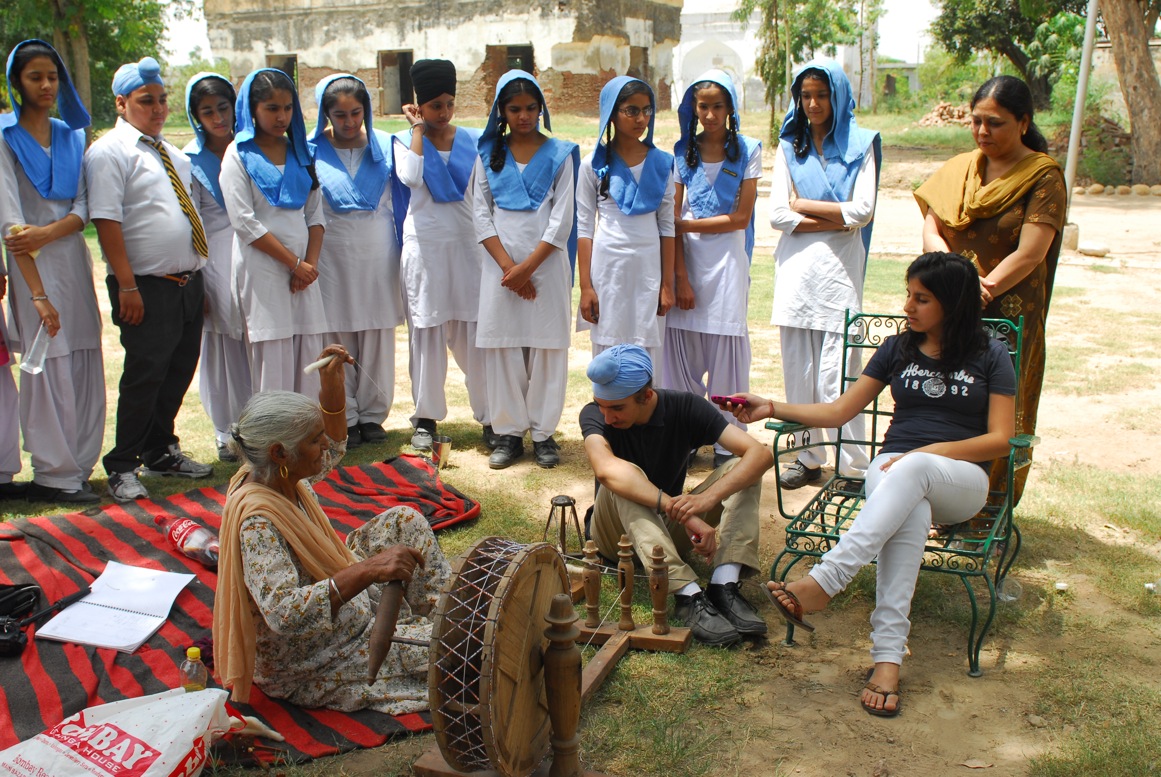
Folk artist (naïve or primitive artist), Bibi Surjit Kaur Bhamra visited the Qila, Sultanpur Lodhi in September last year with her brother, artist Avtarjit Dhanjal and his partner Danielle. Avtarjit introduced her ability to do art with mud – making birds, animals on walls using specially prepared clay. On February 7 this year, I visited her residence when Avtarjit was visiting her at her village, Chakkar, Tehsil Jagraon, District Ludhiana, Punjab.

Avtarjit Dhanjal with his sister, Surjit Kaur Bhamra

During my visit to her residence, I was introduced to two charkhe (spinning wheels), one each hand built by her father and father-in-law respectively. She had been introduced to my intent of starting spinning and weaving here at the Qila as part of the revival of the folk and cultural traditions of the Sultanpur Lodhi region. She was very kind in offering both the charkhe as donation to Anad. Her charkha was part of the dowry she brought from her parents household and the sandook, an old fashioned almirah came from her mother-in-laws’. A week later one charkha and the sandook reached the Qila in a van. We planned that she visit Anad Conservatory site at the Qila at her earliest convenience.

Today, she came. She brought cotton, some of the integral parts of the charkha and even specially prepared mud. Her visit was planned to be a part of the 3-week summer internship programme by 6 students of Vasant Valley School – Kavya Rai, Wanhee Ji, Uday Talwar, Himmat Singh Guram, Anmol Handa and Luigi Hari Tehel Singh. Fourteen students with interest in music and three teachers of Guru Amar Das Public School, Model Town, Jalandhar also came visiting as singing and spinning analogies went along together albeit in a newer age.

The charkha spun again today. Although we all took our turns at spinning the wheel  only she was the ace. She also sang along some of the folks songs traditionally sung while spinning the thread into being:

maa meri ne charkha ditta, vich jadaiyyaaN mekhaaN.
maa tainu yaad karaaN jadd charkhe wal vekhaaN.
and
charkha chandan da maiN kattaaN preetaN naal.

Here are some images of Day I with her:

Anmol the spinner…
Himmat spins as Ravinder Rocky, the poet, looks on…
Luigi practices some…

I try my hand – it was a tough first day at spinning though 🙁
Himmat tries cinematography for a change.

Kavya the spinner 🙂

Luigi Hari Tehel Singh takes a lesson at the spinning wheel.

Receiving applauds for her song.
Surjit K Bhamra sang a song that traditionally went along spinning times.


Bibi Surjit Kaur Bhamra
A bird’s first ever flight…


Visiting a Duree Making Factory

25 Friday May 2012

Posted by bhaibaldeep in Rāngli Sath

≈ 1 Comment

On My 25, 2012 we visited a Duree (carpet) making factory at Nakodar with Dr. Harjit Singh. The owner, Raman Veer Jain, was very welcoming and spent quite a few hours showing the whole process from spinning, dyeing and weaving.

More to follow…


← Older posts
Newer posts →

Subscribe

  • Entries (RSS)
  • Comments (RSS)

Archives

  • October 2026
  • September 2026
  • May 2026
  • December 2025
  • May 2025
  • December 2024
  • June 2024
  • January 2024
  • November 2023
  • May 2023
  • January 2023
  • May 2022
  • December 2020
  • July 2020
  • April 2020
  • December 2019
  • January 2019
  • November 2018
  • June 2018
  • March 2017
  • December 2016
  • August 2016
  • June 2016
  • February 2016
  • October 2015
  • September 2015
  • August 2015
  • July 2015
  • June 2015
  • May 2015
  • April 2015
  • March 2015
  • November 2014
  • October 2014
  • September 2014
  • August 2014
  • June 2014
  • May 2014
  • April 2014
  • March 2014
  • February 2014
  • January 2014
  • December 2013
  • November 2013
  • October 2013
  • September 2013
  • August 2013
  • July 2013
  • June 2013
  • May 2013
  • April 2013
  • March 2013
  • February 2013
  • January 2013
  • December 2012
  • November 2012
  • October 2012
  • September 2012
  • August 2012
  • July 2012
  • June 2012
  • May 2012
  • April 2012
  • March 2012
  • February 2012
  • January 2012
  • December 2011
  • November 2011
  • October 2011

Categories

  • ANAD Discussion Forum
  • ANAD Events
  • ANAD Foundation
  • Anad Initiatives
  • ANAD Khand
  • Anad Lecture Series
  • Anad Luthiery
  • ANAD Obituaries
  • ANAD Poetry Page
  • Anad Residencies
  • Anad Scientific Advisory Committee (ASAC)
  • Enroute to a realisation
  • Guru Nanak Dev University Events
  • Humour & …
  • Lines and Colours
  • Mere Music
  • Oral History Archives
  • People
  • Photos
  • Press
  • Quotes
  • Ravneet Sangha Anecdotes
  • Reflections
    • Postcards from the Journey
  • Responses
  • Rāngli Sath
  • Sarcasm
  • Television
  • Uncategorized

Meta

  • Log in

Culture | Conservation | Continuity

Create a website or blog at WordPress.com Theme: Chateau by Ignacio Ricci.

Loading Comments...