#SangeetNatakAkademi (www.sangeetnatak.gov.in), in collaboration with the #GuruNanakDevUniversity (http://online.gndu.ac.in)
Photomapping of the event by Bhai Baldeep Singh: The event was hosted in premises of the Guru Nanak Dev University with the intention of marking the beginning of the 550th birth anniversary celebrations of Sāhib Srī Gurū Nānak Dev and ushering in the golden jubilee year of the Guru Nanak Dev University. It was literally the whole nation converging together in celebration. As the university’s Dashmesh auditorium was under renovation, the performances were held at the Arts Gallery, Amritsar. As I was travelling back from the US, I missed the first day’s events as well as the Santūr solo performance of Pandit Shiv Kumar Sharma.
Venues Seminar Sessions were held at Seminar Hall, Sri Guru Granth Sahib Bhawan, Guru Nanak Dev University, Amritsar, while the performances held at Art Gallery, Indian Academy of Fine Arts, Madan Mohan Malviya Road, Amritsar. You can find the details on the Akademi site’s link: http://sangeetnatak.gov.in/sna/events_list.php?section=current
Technical Jargon With regards to the equipment used, I still use my fast ageing Nikon D810 but have stopped using the Nikkor automatic lenses, (in mm) 14-24, 24-70, 70-210 and 60 Macro, which are still near-brand new condition. About 3 years ago I bought the ZEISS Planar lenses —T* 2/25mm and T* 1,4/85 mm. ZEISS Camera Lenses have been kind to (sort of) partner by lending their #Otus, #Batis and #Sonnarseries lenses to me for The Anād Foundation‘s documentation and archiving endeavours. Zeiss’s India head, Umender Shah, provided me with the T* C Sonnar 2/135 ZF and which I have mostly used. On the last couple of days, I did carry the Planar T* 1,4/85 along changing lenses every now and then wishing along to have carried along a second camera body. Anyway, do leave a note or two about the shots that catch your imagination, or deserve your ire.
A poem (Punjabi. See bottom for its transliteration in English) by Bhai Baldeep Singh in wake of the gruesome destruction of precious heritage by the Sultanpur Lodhi Police Station cops on May 13, 2018:
They do not know
the storms
the winds
the oceans
I carry
that churn
that rage
are sages within
’tis just that
skies are vast
that Nanak holds
in his karkamalā singingārtī rāga dhanāsri
These are my mortal remains people!
—distracted people, my murderers.
Ignorance is such a bliss,
That adorns itself with five
Ornaments – all obstinate;
Those who have it — Avoid ’em at all times.
There is innocence
Bordering ON foolishness, That often comes educated.
There is ignorance
That wears two bangles
Curiosity and enthusiasm;
In its eyes
A sense of wonderment,
And a flair of innocence!
In life, one must have two strategies.
That is,
When an enemy comes to get
One must know what to do;
When an enemy comes to begotten
One must know what to do.
This is to announce that Bhai Baldeep Singh, Founder and Chairman of The Anād Foundation has finished designing the emblem which shall be used for Gurū Gaurav 350: Celebrating 350th birth anniversary of Sahib Sri Guru Gobind Singh Mahārāj.
This Gurū Gaurav 350 emblem that has actually been calligraphed by BBS and graphically scanned and set by ace graphics designer and Anād’s long time associate, Kamleshwar Singh Batra:
On the visiting cards and posters, the Bihar Administration and Anād Foundation logos have been approved by the concerned authorities to be placed in the following manner:
For 12 days from July 3, 2013 till July 14, 2013, practitioners of Gurbani Sangeet converged at the joint household of Jasdeep Kaur – Kulmeet Singh and Rameet Kaur – Thomas Roddy Hughes, and their fabulous four children. Students gathered from Europe, India, North and South Americas.
Calling this form as “Gurmat” Sangeet it a problem for one cannot sing Guru’s wisdom (Gur-matt) but Guru’s Bani. In any case, perhaps it be spelt with a double ‘t’ in English at the end as – Gurmatt else it reads as a “mat” —guru‘s mat or carpet…
My argument is that all of Gurbani is not Gurmatt – there is a lot of Gurbani or Bani which is merely information; then there is critique, there is lament, there is sarcasm, there is sarcastic humour, there is taunt, there is devotion, eulogy, seeking, questions, history, narratives and so on, and then there is Gurmatt to sum them all. All of Gurbani is sung and hence it was called Gurbani Sangeet by many vidwan-s including Gyani Gyan Singh of Abotabad, Bhai-s Avtar Singh Gurcharan Singh, Professor Tara Singh and others.
There are a few contemporaries of mine (I am not going to discuss their musicianship or scholarship here) who have propagated a few ideas and have successfully, and sometimes unsuccessfully for I am and many others around our tiny-miny globe are not among their takers, been globetrotting in the name of Gurmat Sangeet. They have made good business and a good name while many think they are messiahs of the field, they are technically merely messiahs of distortions and lies about the tradition. For example, some of these contemporaries have merely borrowed the names of the old instruments and got some lookalikes along with some hybrids such as saranda – a mix of sarangi and saranda – made from ignorant instruments makers who had no background or history in learning and making the originals. I even made three short films on the subject in 2008 (Luthiers of Punjab) which were also shown at the Spinning Wheel Film Festival in Toronto.Nevertheless, this will be remembered as an era when a few matt-s or thesis were propounded such as gurnam-matt, surinder-matt, surinder-yoga, dyal-matt, etc. By way of these, these mechanics of sorts have propagated their interpretations, assumptions and estimations that includes many lies, concoctions, fiction and plagiarism, as history. Preliminary evidence suggests that they all have at least some background in learning contemporary music but especially not the heritage of Gurbani Sangeet.Their work lacks semantic precision and, at most times even, academic integrity but remember my purpose here not to engage in these matt-s bashing. I am merely speaking of Gurbani Sangeet.
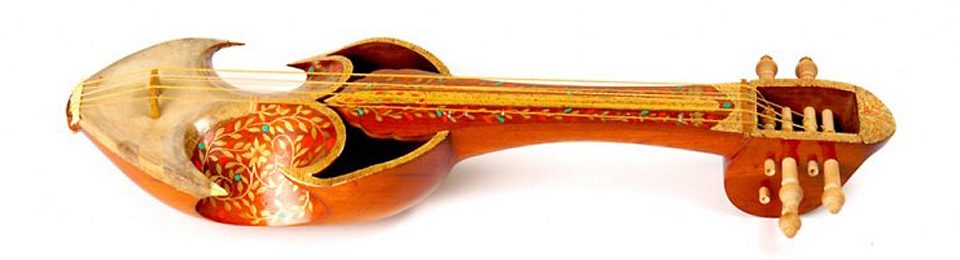
Gurbani Sangeet includes the study of Kirtan, that is, the learning of and singing of Gurbani; luthiery, that is, the art and science of making musical instruments traditionally used in court of the Sikh Gurus and other authors; the playing techniques of instruments such as rabab, saranda, pakhawaj, jori, nagara, kainsian, chimta, been, kingari, etc.; as well as learning of the history and other dynamics of Gurbani Sangeet and its protagonists over the centuries. This 35th biannual retreat, one of its only kind and during which I have had the honour of starting from scratch and then over the years handcarving instruments for my students as well as sharing with them the knowledge of the songs —that yet remains which has come down the centuries
On May 30, 2016, Bhai Baldeep Singh, Chairman, The Anad Foundation, visited the residence of one of the world’s living legend sārangi maestros, Pandit Ram Narayan. Pandit Narayan speaks chaste Punjabi having worked at All India Radio (AIR), Lahore, until the partition of 1947. This visit was more about Pandit Ji hearing some of the ancient compositions of Gurbani and Khandarvani Dhrupad.
Here are some images that Bhai Baldeep Singh took of the maestro and his illustrious son, sarod maestro, Pandit Brij Narayan.