• About The Anād Foundation
    • Aims & Objectives
    • Governance
      • Board of Advisors 2026-2029
      • ASHA 2026–2029
    • Trustees & Associates
    • Historical Records
      • Founder Trustees
        • Bhāī Baldeep Singh
          • First visit to the Qila
        • Chiranjiv Singh
        • K. T. S. Tulsi
        • Kiranjit Singh Bawa
        • Manjit Kirpal Singh
        • Pervinder Singh Chandhok
        • Raj M. S. Liberhan
        • Ranjodh Singh
        • Ravinder Singh Ahuja
      • Board of Advisors
        • Rear Admiral Kirpal Singh, AVSM
        • Major H. P. S. Ahluwalia
      • Associate Trustees 2008-2011
      • Associate Trustees 2011-2014
      • Associate Trustees 2014-2017
        • Mayank Singh Bawa
      • Associate Trustees 2017-2020
      • Associate Trustees 2020-2023
    • Team & Project Associates
    • Financial Highlights — Archival Record
  • Anād Khaṅḍ / Conservatory
    • Anād Khaṅḍ — The Proposal
    • The Institute
      • Faculty
        • Resident Faculty
        • Visiting Faculty
      • Learning Streams
        • Class With Bhāī Baldeep Singh
        • After-School Studies
          • AAS Study Programme Coordination Committee Meeting I & II
      • Workshops
        • Gurbāṇī Saṅgīt Workshops
          • With Bhai Gurcharan Singh
          • With Bhai Baldeep Singh
            • BBS I
          • With Ustad Harbhajan Singh Namdhari
        • Dance Workshops
          • Kathak with Maria Maurizia Costanzo
            • Maurizia’s Workshop Note
            • Gallery
          • Chhau Dance with Luisa Spagna
            • A Note by Luisa Spagna
        • Theatre Workshops
          • With Kuljeet Singh
            • Theatre in the spaces
            • Gallery
        • Photography
      • Outreach
        • 2018: Poznań, Poland
        • 2019: Poznań, Poland
        • 2025: Rovigo, Italy
      • Gallery
    • ANĀD Scientific Advisory Committee 2009-2017
      • First Thoughts
        • By Professor Paolo Ceccarelli
        • By Professor Rabindra Vasavada
        • By Ashok B Lall
    • Costs and Funding Framework
    • Luthiery School
      • Rabāb
        • Harbhajan Kaur’s Rabab
      • Saranda
      • Taus
    • Audio-Visual Restoration Studio
  • Gurū Gaurav 350
    • Guru Gobind Singh — A Prophet With Difference
    • Gurū Gaurav — A Concept Note
    • Gurū Gaurav — Press Release
    • Performers
      • Rânsubāi
        • Inauguration
        • Raghuvir Mallik
        • Sangeet Kumar Pathak
        • Bibi Ashupreet Kaur
        • Ashutosh Upadhyay
        • Dr. Alankar Singh
        • Vidushi Jyoti Hegde
        • Bhai Baldeep Singh
        • Pandit Ram Kumar Mallick
        • Bhai Balbir Singh Ragi
        • Bhai Baldeep Singh —Poetry Reading
        • Pandit Rajendra Gangani
        • Pandit Yashpaul
        • Mohan Shyam Sharma
        • Jagat Narayan Pathak
        • Nihal Singh
        • Indra Kishore Mishra
        • Dr. Anil Chaudhary
      • January 1, 2017
        • Guru Gaurav Event Hosts
        • Introductions
        • Pandit Ravi Shankar Upadhyay
        • Dr. Ajit Pradhan
        • Dr. Nirinjan Kaur Khalsa
        • Ustad Asheesh Khan
        • Poet Kulwant Singh Grewal
        • Bhai Baljit Singh Namdhari
      • January 2, 2017
        • Dhaddi Desraj Lachkani
        • Poet Jaswant Singh Zafar
        • Parminder Singh Bhamra
        • Manu Seen
        • Shekhar Sen
        • Pandit Prem Kumar Mallick
      • January 3, 2017
        • Nashir Naqvi
        • Pandit Uday Kumar Mallick
        • Baha’ud’din Dagar
        • Vidushi Gopika Varma
        • Pandit Vinod Pathak
        • Jasbir Jassi
      • January 4, 2017
        • Pandit Ram Prakash Misra
        • Manganiārs
        • Samiran Sanyal
        • Dr. Gurinder Harnam Singh
        • Sukhwinder Amrit
        • Suvir Misra
        • Dr. Madan Gopal Singh
      • January 5, 2017
        • Jago Tareenjan Group
        • Dr. Francesca Cassio
        • Ustad Daud Khan Sadozai
        • Songs of the Khalsa
        • Dr. Ritwik Sanyal
        • Dr. Umayalpuram Sivaraman
        • Dr. Surjit Patar
        • Bhai Baldeep Singh —Gurbāni Pade
    • Review II by Professor Gajendra Narayan Singh
    • Production Team
  • Heritage Conservation
    • Intangible Heritage — Sūkham Virsā
      • Luthiery Tradition
    • Tangible Heritage — Sthūl Virsā
      • Qila Sultanpur Lodhi
        • Lahore Gate
          • Heritage Hammered by IP Singh
        • Darbar Hall
        • Old Kacchehri (Colonial structure)
        • Delhi Gate
        • Mosque
        • Qila Walls
    • Technology Partners
  • Punj-Care Initiatives
  • Events
    • Full Moon Events
      • May 2011
        • 6th Kāv Tarang Review
      • September 2011
        • Gallery
      • February 2012
      • October 2012
        • October 2012 Punya Baithak Gallery
        • 2012 10 29 Punyā Baithak Press Reviews
    • Poetry Festivals
      • 7th Anād Kāv Tarañg
    • Theatre
      • Story-telling by VK
    • Archives
    • Laya Darshan: Revealing the Riches of Indian Rhythm
    • Jashan 2006
    • 2008 Dharati Suhāvī
    • 2013 Harī Rāgu Gāthā: 31-Rāgu in Gurbāṇī
    • 2014 Hari Rāgu Gāthā: Singing of 31 Rāg in Gurbāṇī
    • Jashan 1915-2015
    • Gurū Nānak Dēv 550th
    • Virtual Vaisākhī 2020
    • 2020 Rai Radio3 — Dharati Suhāvī
    • 2020 Expressions on Nature: Dharati Suhāvī
  • Anād Awards
    • Award Jury
    • Anād Sanmān
      • Jashan 2006
        • Jashan 2006 Review
    • Kāv Sanmān
      • 2008
        • 2008 Review
      • 2009
        • 2009 Review
      • 2010
        • 2010 Review
      • 2011
  • Study at Anād
    • Gurbāṇī Saṅgīt Retreats
      • Retreat 61: Sikh Academy, Surrey, BC
        • Retreat 61: Ṭīkā Tipada Rāgu Mēgh
        • Retreat 61: Bilāvalu Ṭīkā — ‘Aman’
        • Retreat 61: Bilāvalu Ṭīkā — Sūlfākh & Ḍhāī
        • Retreat 61: Dhurpadā — Rāgu Sāraṅg
        • Retreat 61: Kaliān Sargam — SRG & GMP
        • Retreat 61: Rāgu Ṭikā Śuddh Malār Kul-mitra
        • Retreat 61: Rāgu Sūhī Ṭīkā
        • Retreat 61: Rāgu Sārag Āo Jāo
        • Retreat 61: Rāgu Śuddh Malār Tadra Dānī
        • Retreat 61: Āsāvarī Ṭīkā — Sūltāl
      • Retreat 25: Merced, California January 2010
        • Gallery
      • Retreat 26: London, Ontario
      • Retreat 27: Tucson Arizona January 2011
        • Love Poem
        • Gallery
      • Retreat 28: Espanola, New Mexico, July 2011
        • Amrita Kaur Khalsa
        • Gurkaran Singh
        • Guru Mander Kaur
        • Gurumukh Singh CPA
        • Harbhajan Kaur Khalsa
        • Keerat Kaur Chahal
        • Nihal Singh
        • Nirvair Kaur
        • Raviraj Singh
        • Siri Sevak Kaur Khalsa
        • Gallery
      • Retreat 29: London, Ontario 2011-12
        • Student Reviews
          • Keerat Kaur I
          • Keerat Kaur II
          • Baljinder Singh Bassi I
          • Baljinder Singh Bassi II
          • Baljinder Singh Bassi III
          • Tanvir Singh Suri I
          • Tanvir Singh Suri II
          • Harkamal Singh I
          • Raviraj Singh I
      • Retreat 30: Qila, Sultanpur Lodhi 2012
        • Concert inside Kapurthala’s Modern Reform Centre, February 18, 2012
        • Mid-term Review by Nirvair Kaur
        • Review by Nadar Nihal Singh
      • Retreat 31: Albuquerque, NM
        • Nirvair Kaur’s Review: 31st Albuquerque Summer Kirtan Course
        • Keerat Kaur’s 31st Summer Retreat Review
      • Retreat 32: Mississuaga, Ontario
        • Keerat Kaur’s Course Review
      • Retreat 40: Albuquerque, New Mexico
        • Gurbani Sangeet Retreat Review: Nihal Singh
      • Retreat 42: Rajgir, Bihar
      • Retreat 48th: New Delhi
      • Retreat 51: Online from Anād HQ
      • Retreat 52: Online from Anād Foundation HQ
      • Retreat 53: Rochester, MN
        • Rochester Preview & Screenshots
      • Retreat 54: Seattle, WA
      • Retreat 55: Seattle, WA
      • Retreat 56: San Francisco, California
      • Retreat 57: Surrey, BC
      • Retreat 58: San Francisco, California
      • Retreat 59: Khalsa Centre, Canada
      • Retreat 60: San Francisco, California
    • Anād Online
      • Anād 31
        • 4. Rāgu Āsā
          • ‘Sō Daru’ Rāgu Āsā Jaitāl — Satināmu Sirī Vāhigurū Sāhib Jī
        • 24. Rāgu Bhairau Sūrtāl
      • Anād Online Classes Log
    • Internship Programmes
      • Vasant Valley School Class XI 3-week Internship 2012
        • Chairman’s letter to Vasant Valley School Internship Students
        • Delhi Head Office – Tentative Schedule
        • Student Reviews
          • Anmol Handa
          • Himmat Singh Guram
          • Kavya Rai
          • Luigi Hari Tehel Singh
          • Uday Talwar
          • Wanhee Ji
        • Vasant Valley School 2012 Internship – Images 1 – Delhi
  • YaarAnād
  • Contact Us
  • Donate / Support Anād
  • YaarAnād Virtual Baiṭhaks
    • YaarAnād Virtual Baiṭhak – Season I
      • 2020 April
      • 2020 May
      • 2020 June
      • 2020 July
      • 2020 August
      • 2020 September
      • 2020 October
      • 2020 November
    • YaarAnād Virtual Baiṭhak – Season II
      • 2020 December
      • 2021 January
      • 2021 February
      • 2021 March
      • 2021 April

The Anād Foundation

~ Culture | Conservation | Continuity

The Anād Foundation

Category Archives: Postcards from the Journey

Postcard 18 and 19: No Worries and Shabd Surat Dhun

18 Sunday Mar 2012

Posted by in Postcards from the Journey, Reflections

≈ Leave a comment

Tags

gurmat sangeet, Nirvair's blog

Postcard 18
3/13/12
No Worries

Two sloks from Guru Arjan, originally composed in rāga gauri, offered here in rāga āsā.
Two lines each, that tell you basically all you need to know.

“Support of the souls is the One, (yet) you attach your hope to dependence on others.
Nanak, Meditate on the Name and all your affairs will be set right”

and

“Rise at dawn, chant the Name, continue the worship day and night.
Anxiety won’t stick to you, Nanak, delusion is erased.”

There are so many descriptions, so many practices, so many songs. We have been shown so many things. But fear and worry set in anyway, stress takes over. The solution is simple– clear the mind, remember the Name, trust the True Support, get real. No worries.

Postcard 19
3/14/12
Shabd Surat Dhun

Among the Sikhs there is a growing interest in the rāgas of Siri Guru Granth Sāhib and there are various teachers and institutions working to revive Gurmat Sangeet. Traditional kirtan, however is more than rāga (melody), which is just one leg to support the experience. The other legs include tāla (rhythm), bāni (words) and chit (focus, the inner state). Like an uncomfortable rocking stool, the music will be shaky if the legs are out of balance.

The rich variety and complexity of the tāla tradition parallels the musicality of the rāga tradition. For example, in just ten pages of rāga āsa compositions, there are seven melodies in ten different tālas for the poetry of six shabds. How is it possible to have one rāga with seven unique melodies in ten different tālas? Part of the answer is that two of the compositions are partāls which change tāla in various parts of the song. One of the partāls has four different tālas!

The more common eight-beat and sixteen-beat tālas are represented here with tālavāra and choti teentāl, but so are two different fourteen-beat cycles, tāla āda and tāla dhamār, as well as tala dāee, which is in seven beats. Sultāl, ten beats, is here along with chartāl and iktāl, both twelve-beat cycles, one slower and one faster. Rarer tālas are also present such as sikhar tāla, seventeen beats, and tala bhān matee, eleven beats.

These pages are an amazing cross-section of a fifty-one-page collection of shabds in rāga āsā. If ten pages of compositions in one raga can be this rich in memory, it is a small glimpse of what is possible and an invitation to keep exploring to discover what else will be found on the next page, and the next.


2 Amazing Days at the Qila…

16 Friday Mar 2012

Posted by bhaibaldeep in ANAD Foundation, Postcards from the Journey

≈ 2 Comments

Two amazing days at Sultanpur Lodhi and around.

Instrument making – working on the taus for cousin Bhai Kultar Singh and Younis Khan making accessories for my saranda.

Namaz being offered by Younis at the Mosque (once again after what, a century? 🙂 where Guru Nanak taught how to…!

On the night of March 13, I visited Sri Guru Amardas Simran Kendra set up by uncle Sardar Hardial Singh IAS (Retd.) in his farm at Village Khiranwali, Kapurthala. Parmjit Singh who recently retired from the Cultural Affairs Department also sang a shabad after a short manglacharan in raga darbari kanada. Then I sang a shabad by Bhagat Namdev in raga malkauns. Nadar Nihal Singh is staying there now for a few days to learn meditation techniques.

The next morning a small truck brought a sandook (traditional chest) and a charkha (spinning wheel). Both were sent by Bibi Surji Kaur Bhamra, a sister of noted artist Avtarjit Dhanjal, from Village Chakkar, District Ludhiana. The spinning wheel was made by their father. There is another wheel made by her father-in-law which will arrive in a few days and we plan to have some textile and fashion design students from the area and from as far as Chandigarh over when Surjit Kaur Bhamra will visit and do some art-work on the mud walls and assemble the spinning wheels.
As the goods were being offloaded, a cop named Arvinderjit Singh Thind, offered one of his own sandook. He kept a slightly bigger one for himself. An old house adjacent to house of the kind constable belonged to the family of artisans (carpenters) but who had no heir. I am planning to meet the extended family and request them to give the house to ANAD or even rent it out.

On the way back to Delhi, I stopped over at Nawanshahr to meet a local instrument maker, Gyani Kishan Singh and also his elder son.

On the 15th, Swami Madhusudan visited with the talented Dhruv Sharma and we sang…

Raga Bhairavi
Dhruv is a fine talent
With Swami Madhusudan of Brindaban

A student
A luthier, Gyani Krishan Singh
A luthier

The cop and his grandmother’s sandook
Sandook II on to the truck
Once, when the cops grandmother had wed, this sandook had been brought into the house – this time, it is taken to its rightful place in Anad Conservatory’s museum at the Qila

Emptying the secret vault..!
Helping hands

Kunda
Parmjit Singh in a sweet gesture – brooms the chakki
Chakki (grinder)

Chulha (mud-oven)
The storage at the cops house
The generous cop and his wonderful wife…

Where the lamps were once lit…
When disregarded, even a flower wilts …
And the roof

What a window!
A beautiful door
A carpenter’s house whose has since died with no heirs.

Letter box
A beautiful tree…
Charkha and Anad Conservatory Site office

Then a cop came up and said I have two at home and willing contributed one of them for the collection – less than half hour later, we were in his village…
Sandook and Charkha
And the Charkha

Sandook offloading
Backing up

Arrival of the sandook and the first charkha – gifts by Surjit Kaur Bhamra and Avtarjit Dhanjal
Uncle Sardar Hardial Singh, founder of the Sarab Rog Ka Aukhad Naam Mission and Sri Guru Amar Das Simran Kendra
Malkauns – Mangalacharan and Bandish

Tuning the tanpura
Parmjit Singh sings with me playing Pakhawaj
Advocate Shaili is to ties his noose (knot) on the 18th

Planing III
Planing II
Younis working on the taar-daan (ebony wood)

Lines after preliminary planing
Planing – Making the fretboard of the taus being hand-crafted for Bhai Kultar Singh Ragi
Where Guru Nanak once came to teach how offer – Younis offers his Namaz – so beautiful to see the Mosque being brought back to life…

Nadar Nihal Singh, saxophonist from Tucson, Arizona now practicing pakhawaj at Anad Conservatory.
Setting the stencil
Done yet..?

Preparing the bed for the taar-daan VII – Filing, with Younis helping hold the saranda in position
Preparing the bed for the taar-daan VI – Filing III
Parmjit and uncle Raghbir Singh admiring the custom files

Preparing the bed for the taar-daan V – Filing II Parmjit Singh, Raghbir Singh, Younis Khan and Jatinder Bhamra.
Preparing the bed for the taar-daan IV – Filing
With Police Sergeant Resham Singh, an outstanding ‘chimta’ player and whose son is quote talented – now a student at Anad Conservatory.

Preparing the bed for the taar-daan III – With mallet and gouge
Preparing the bed for the taar-daan II – Gouging
Preparing the bed for the taar-daan I

Making the stencil of the taar-daan for Younis III – Instructions
Making the stencil of the taar-daan for Younis II
Making the stencil of the taar-daan for Younis I

Postcard 17: Dreamers

14 Wednesday Mar 2012

Posted by in Postcards from the Journey, Reflections

≈ Leave a comment

Tags

gurmat sangeet, Nirvair's blog

3/12/12
What kind of dreams do you dream? Can you put your dreams into words? If your dreams are like mine, they might be absurd, confusing, rarely profound, hard to describe. Can you imagine having a dream that is a vision of God permeating nature? What if the dream became a poem and the poem became a song? And what if someone found the song, perhaps centuries later, and made a new song that expresses in the melody the depth and breadth, the height and delight of the dream itself?

Bhai Gurdas Ji was a co-traveler with the Gurus themselves. He wrote and composed poetry and ballads in praise of the One, in praise of the Gurus, and describing the experiences of the spiritual life. Only his songs, along with bāni from Siri Guru Granth Sāhib, Dasam Bāni and Bhai Nand Lal’s ghazals are allowed to be sung in the Guru’s darbār. Over the centuries the kirtānyās created new melodies for these poems, just as they composed melodies for the guru bāni.

In rāga gauri, Bhai Gurdas describes a marvelous dream of the beloved, a fantastic vision of the friend. In Gurbāni Sangeet there are two melodies in raga āsā that the tradition has remembered for singing this dream poem. One kirtānyā, we do not know who it was or in what century, placed the poem in a partāl, a complex dhrupad composition in which the tāl changes from asthai to antarā to sanchāri and abhog.

The song begins with asthai, the refrain, in chartāl, a twelve-beat rhythm which conveys the deep meditative state of the dreamer. For the antarā, the stanza, the tāl switches to iktāl, a faster twelve-beat rhythm, which begins to convey the enjoyment of the dream, the heightened state of communion, drinking the joy. The sanchāri comes in tālvāra, 8 beats, simply sustaining the meditation, delivering the love, savoring the contentment. The abhog begins in sultāl, 10 beats of delight and ecstacy, like a birdsong, celebrating the miracle of the vision, then returns to chartāl for the final lines, describing the dreamer’s awakened state of clarity, swimming in love, like a fish in water.

Once again, I am in awe. Who were these people and how did they compose these words and this music? What did they know, what did they practice, where did they dwell? And I am grateful for those who remembered, who kept the music alive, the kirpā that placed this page in front of my eyes today.

Postcard 16: Detours

11 Sunday Mar 2012

Posted by in Postcards from the Journey, Reflections

≈ Leave a comment

Tags

Nirvair's blog

If my journey through the volumes of Gurbāni Sangeet is a road trip from sri rāg to rāg jaijāwanti, then I have taken a month-long detour along a side road that took me to India and London where I met other kirtan travelers and hopefully picked up some more tools during the kirtan retreat at the Qila in Sultanpur Lodhi that will be useful for the travels.

Back home, back to the rest of the family, back to day-to-day routines, back to work, it’s also good to be back in my little room, to enjoy time alone, to resume a regular practice and to get back on the road where I left off with rag āsā. I’m realizing that it is a winding road, a circular path, and revisiting the songs, new ones and those previously learned, enriches the journey. A straight path is simple, predictable and saves time, but the twists and turns of a non-linear route have an irresistible appeal. The self-imposed time-line may be more like a spiral and we will see how it fits inside a one year cycle.

This weekend we took another little side trip and hosted a one-day camp for Sikh children in Tucson, sharing with them the legacy of the Gurus, the Sikh martyrs, the institutions and traditions remembered every day in Ardās. While the children met with their guides, we had a conversation with the parents. What was life like for the great souls we remember? What was the state of prayer for them? How do ordinary people come to do extraordinary things? How does a conquered people remain undefeated? How do we achieve the inner victory?  How have the Sikhs maintained cherdi kalā even while remembering unbearable atrocities? What are the modern-day challenges to the spirit of the sarbat khālsā? We pray for victory and we pray that our memory, traditions and institutions will prevail for all time.  What have we already forgotten? What has already been lost? What will we give the next generation to carry forward?

Postcard 15: Mind the Gap

03 Saturday Mar 2012

Posted by in Postcards from the Journey, Reflections

≈ 2 Comments

Tags

Nirvair's blog

After our stay in Sultanpur Lodhi, I travelled with my daughters and granddaughter to Ludhiana, Patiala, Chandighar, Delhi and London where my eldest, Nirinjan Kaur, continued her research on Sikh Kirtan and its practitioners.

During my early morning meditation in the hotel room my mind suddenly went somewhere else this morning. “How did I end up here?” I wondered, when I realized my focus had shifted. After days of traveling on the Metro in Delhi and the Underground in London I instantly heard the warning of the sweet female voice, reminding us to “Mind the gap!”. This is the constant advice you hear for boarding and stepping off the trains, to watch out for that space between the platform and train. How easy to mindlessly leave the steady platform of focus and awareness, letting the mind take off on a track of its own. Do we even notice when we’ve crossed over? Stepped out of remembrance and started traveling? Down the line there are infinite possibilities for connections, destinations, places to visit for a while. If you catch the Heathrow Express, you could end up on another continent! And then we wonder, “how did I get here?”

So that is the reminder for today as we literally prepare for international travel, home to the US, and as we prepare the mind for meditation. “Mind the gap”, step with awareness, be present, remember your home as you travel, maintain the awareness as you work in the world. The daily practice is just that- practice for real life. When I learn to focus in my quiet room, I can mind the gap in a noisy crowd.

Postcard 14: Kahu Geet Ke Gavaya

26 Sunday Feb 2012

Posted by in Postcards from the Journey, Reflections

≈ 5 Comments

Tags

gurmat sangeet, Nirvair's blog

In Sultanpur Lodhi we met for twelve days to sing kirtan and to support the work Bhai Baldeep Singh is doing there to transform an old fort into a conservatory of music, culture and tradition. The community welcomed us and we visited in many homes in town and in the villages where we were greeted with flowers, fruits,  warm hugs and feasts of delicious Punjabi dishes.

Nirvair Kaur plays Taus at the Kapurthala prison.

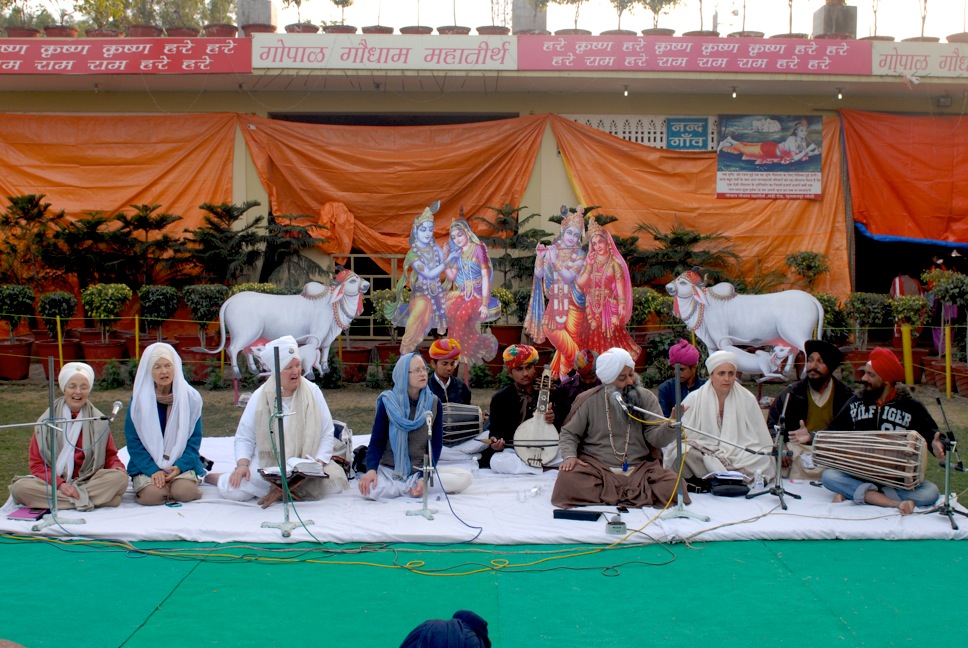
We also sang at a television station, a prison, a home program, and a cow shāla. All of these were unique experiences. For the television program, Bhai Baldeep was joined on stage by a diverse group of men and women who came together to sing kirtan. The variety of instruments and headdresses illustrated the presence of Muslim and Hindu musicians along with Sikhs from various communities and countries, a colorful garden singing in rāga basant, “The sky blooms, the earth blooms, the Lord King blooms in eternal love, everywhere you look. The Vedas bloom, the Smritis bloom, the Bible and Koran bloom. Shiva blooms in yoga and meditation, Kabir’s master is in everything just the same.” When this program airs, the viewers will see something very different than the usual image of matching rāgis with harmonium and tabla. The listeners will hear a new sound that is also very old, when they hear rāg basant delivered by Bhai Baldeep Singh, accompanied by stringed instruments and Parminder Singh Bhamra on pakhāwaj.

BBS singing Bhagat Namdev's "mokau taar le rama..."

At the prison, we looked out from the stage at bleachers filled with inmates, official guests and prison workers. Bhai Baldeep reminded the group gathered there that he, too, is a prisoner of the mortal body and it’s five wardens. He sang, spoke and joked with the “captive audience” who were treated to a program unlike any they had seen before. The jailers and jailed even joined in singing moko tārle rām. “Swim me across, Lord, I’m ignorant and know nothing about swimming, Dear Father, give me your hand”. The program was an oasis of beauty in a stark, grey, concrete world. The posters and invitations had named the program, “Reviving the Spirit”, and judging by the laughter and spontaneous rounds of “Bole Sone Hāl” from the stands, it seems to have done just that.

Almost every day we had one or more meals in homes in the community. Often the Manganiar boys from Rajasthan would be asked to perform for our hosts. One night we went to dinner in the village and found that a stage had been set up in the courtyard. Several local musicians performed as the assembled folk stayed warm under piles of quilts brought out by our hosts. The Manganiar boys sang beautifully. Although most of our group doesn’t speak or understand Punjabi, we knew the women were being asked to sing when we heard the word “bibi” in the announcer’s message. Fortunately we had taus and electronic tānpura with us and four foreign women sang in rāg tilang.

Nirvair feeding the black cow

The cow shāla is a little piece of heaven on earth, especially for the animals that live there, a centuries-old temple that cares for cows with the kind of devotion reserved for the divine. The animals are beautiful, healthy and gentle. We were handed trays with piles of aromatic greens and home-cooked cakes of porridge and invited into the barns to hand-feed the sacred cows. I especially enjoyed the black one who was being milked as I held out the treats and she stretched her long tongue to grab the snack, curling and flexing it as if she had a thumb attached. We joined Bhai Baldeep on stage to sing in sangat with people and cows. After the program we were treated to fresh, warm, sweet, cardamom-scented, milk. As the sun sank in the sky, local children filled the courtyard and the shāla began its evening distribution of free milk. With prevalent attitudes of mistreatment of animals, it is comforting to know that such a place exists in the world.

The concert at the cow shelter.

Throughout our stay in Sultanpur Lodhi, we encountered the memories of this ancient town, which is at least two thousand and five hundred years old. It has been a center of culture, trade, spirituality and learning for Buddhists, Hindus, Muslims and Sikhs. Guru Nanak lived here for fourteen years, started his family, and began teaching. A few relics from the time of Guru Nanak remain, but most of the historically significant sites have been replaced with new gurdwara construction as a type of monument to the past. The town was known for beautiful orchards, gardens and surrounding forests, which have now become expansive stretches of flat green farmlands.The Qila, an ancient fort, where we met for the kirtan workshop is home to a  pre-Mugal-era mosque that Guru Nanak himself had visited, the remains of the darbār hall of the King of Kapurthula, colonial-era barracks, and modern-day police offices. It is a place where past, present and future intersect. For the future, Bhai Baldeep envisions a massive restoration effort to preserve what remains of a significant past for the Qila and for the town, while developers are already staking out the ancient undeveloped lands owned by local farms for new housing markets.

In twelve days, Sultanpur Lodhi found a permanent place of residence in our hearts and we will treasure memories of our time there, the learning we engaged in at the Qila, and the community that became our new extended family.

Sultanpur Lodhi
The One in the cow,
The One in the cow herder,
The One in the singer, the string-player and drummer,
The One in the listener, the One in the song.

The One in the child,
The One in the mother,
The One in the young beauty with a red part in her hair,
The One in the gray-haired elder with glasses.

The One in the prisoner,
The One in the guard,
The One in the dignitaries who sit proudly,
The One in the hopeless who sit with shoulders slumped,

The One in the giver of garlands,
The One in the teacher who receives the praises,
The One in the student,
The One in the driver and cook.

The One in the ladies turning chapatis over the fire,
The One in the gentlemen sitting in chairs,
The One in the parrots,
The One in the trees.

The One in the relics of the past,
And hope for a future where they will last.
The One who has always inhabited this place,
The One who brought us here, by His grace.

2-20-12
Car vandalized

18 Saturday Feb 2012

Posted by bhaibaldeep in Postcards from the Journey

≈ Leave a comment

At about 6:15pm, inside the residence of Rohit Khanna in New Jawahar Nagar, Jalandhar, we listened to some vigorously presented music by the Manganiar proteges, Roshan Khan on the kamaycha, Sawai Khan (vocal), a fascinating Dara Khan on the dholak and Rafiq Khan (khartal) but outside on the road, my car was vandalized. Thieves broke into my MUV through the rear-left-side window and stole my TUMI carry on. There were my personal manuscripts, 8-9 hard-drives and some clothing. A pity that the taxi driver sat in side his car (hired by us) remained unawares..!

Postcard 13: Rag Asa at Dusk

12 Sunday Feb 2012

Posted by in Postcards from the Journey, Reflections

≈ Leave a comment

Tags

gurmat sangeet, Nirvair's blog

At dusk in Sultanpur Lodhi rāga āsā appeared as Bhai Baldeep Singh began alāp. As the melody opened up, he requested the Manganiar musicians to sing something in rāga āsā from their tradition. From deep inside Rajasthan, the notes of āsa were the same. Singing in perfect unison accompanied by kamaicha, dolak and kartal, the form of rāga āsā was remembered just as the gurbāni sangeettradition has remembered it.

Rāga āsā is meant to be sung when the sun is at the horizon, rising or setting. As the evening grew dark, Bhai Baldeep taught the group of Rajasthani, Punjabi, Italian and American students as he sang a traditional āsā composition from gurubāni in sikar tāl, a seventeen beat cycle. “Rise early, chant night and day, you won’t have anxiety and misfortune will vanish.” For me these are the perfect words, the perfect reminder.

The Rajasthani tribes share similar roots with the rabābis who have participated in Sikh music since the beginning, when Guru Nanak gave a rabāb to Mardana right here in Sultanpur Lodhi. Until recent years, musicians from these groups have included some gurubāni in their repertoire. On this night, gurubāni is returned to a new generation.

This shabd by Guru Arjan Dev Ji in rāga āsa is one of the songs on my “to-do list”. How can you compare scraping a composition out of the notation and receiving it from a teacher? The former is like unearthing a skeleton, the latter is like meeting the ancient one, full of life, in flesh and blood, decorated with fine clothes and ornaments. The instruments complete the setting, filling the room, giving the rāg some furniture to sit on. Unearthing dry remains can certainly be an exciting discovery. Meeting a living treasure at home is a different kind of miracle.

Postcard 12: When Sāg is like Dessert

09 Thursday Feb 2012

Posted by in Postcards from the Journey, Reflections

≈ Leave a comment

Tags

gurmat sangeet, Nirvair's blog

Kaurs - the little Dhyana, Nirinjan, Harbhajan, Nirvair, Siri Sevak, Gurushabad, and Nadar Nihal Singh...

There is one shabd by Bhagat Kabir Ji in rāga maru that appears in three different rāga āsā compositions in Gurbāni Sangeet. What is it about this bāni that inspired the old kirtānyas to sing it over and over again, creating new melodies in different rhythms–pancham sawāri and tāl talvārā? Why did they like this shabd so much?

“O king, who will come to you? I have seen such love from Bidur, that the poor man is pleasing to me. Gazing upon your elephants, you have gone astray in doubt; you do not know the Great Lord God. I judge Bidur’s water to be like amrit, in comparison with your milk. I find his sāg to be like kheer; the night of my life passes singing the Glorious Praises of the Lord. Kabeer’s Lord and Master is joyous and blissful; He does not care about anyone’s social class.”

It’s easy to see why the ones who have chosen to walk on the path of kirtan love this bāni. They have found delight in the simple pleasures, realizing the distraction of possessions–in Kabir’s day, elephants, today perhaps it would be a Ferrari. They are delighted singing the praises, to them nām is delicious, their thirst is quenched.

Being in Punjab, this bāni is especially relevant. The pleasure of a good plate of sāg really is as good as dessert! We are in Sultanpur Lodhi, away from the comforts of home, meeting in an old fort that is also the home to a mosque visited by Guru Nānak and a darbār hall that once hosted important meetings with the king of Kapurthula. The king’s hall is now a ruin, but the songs that were sung at that time yet remain. The modern comforts and conveniences we are used to might not be here (although we do have wi-fi!), but how do you explain the comfort of a warm cup of cardamom-scented hot milk on a cold night, or a cup of hot tea and aloo paratha after morning practice? And in the evening, when the bones are tired and the chill sets in, what is more satisfying than singing and hearing rāga kalyān accompanied by kamaicha (bowed rabab), dholak and kartal?

Inside the Qila (fort) at Sultanpur Lodhi, home of Anad Conservatory

06 Monday Feb 2012

Posted by in Postcards from the Journey

≈ Leave a comment

Our bi-annual kirtan course with Bhai Baldeep Singh, which previously only took place within North America, is being held in India for the first time – at the Anad Conservatory at the Qila (fort), Sultanpur Lodhi, which is undergoing restorations under the supervision of Bhai Baldeep Singh.

Lahore gate in Sultanpur Lodhi, from Guru Nanak’s times, an entrance to the Qila (fort), where Anad Conservatory is being developed.
 Sultanpur Lodhi was not only the place where Guru Nanak got married and where his sons were born, including Baba Siri Chand – but it is also where Guru Nanak received mul-mantra, became Guru, and from whence he began his teaching yatras.
Delhi gate, in the Sultanpur Lodhi Qila. Some Anad Conservatory events have taken place in front of this artifact, lit by floodlights and full moon.
Darbar of the King of Kapurthala (faces the mosque)

Front view of mosque: Mosque where Guru Nanak was invited to do Namaaz (prayer) by the Nawab Daulat Khan Lodhi, Governor of Lahore.
The back view of the mosque
Guru Nanak pointed out to the Nawab that the Nawab himself wasn’t doing namaaz as he was preoccupied with the worry of a newborn calf of his falling into this town well, which still exists.

Siri Sevak Kaur holding Harbhajan Kaur’s rabab to show the lovely grain of the teak wood.

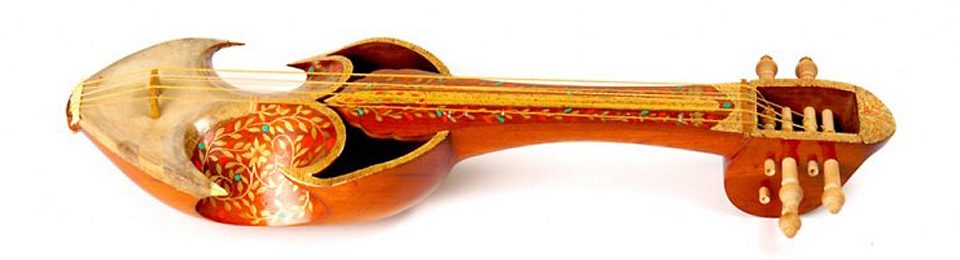
Harbhajan Kaur’s rabab, made by Bhai Baldeep Singh, is waiting for its “skin” at Sultanpur Lodhi. Bhai Baldeep Singh replicated Guru Arjan’s rabab in design (though Bhai Baldeep will use his own way of applying the skin that does not involve nailing the skin to the rabab, and he has carved the motifs in a 3-dimensional relief.) Parminder Singh (foremost pakhavaj student and apprenticing instrument maker of Bhai Baldeep Singh’s) with Sharanjit Singh, a ragi local to Sultanpur Lodhi. Parminder Singh has been doing some cleaning of the carving and polishing on the rabab carved by Bhai Baldeep Singh.
Bhai Baldeep Singh holding the taus he is making for Kulmeet Singh. Note that the technique Bhai Baldeep Singh has created for applying the skin does not involve nailing the skin to the wood.
Siri Sevak Kaur inside the darbar

Inside mosque – some paintings depicting Guru Nanak’s visit.

← Older posts
Newer posts →

Subscribe

  • Entries (RSS)
  • Comments (RSS)

Archives

  • May 2026
  • December 2025
  • May 2025
  • December 2024
  • June 2024
  • January 2024
  • November 2023
  • May 2023
  • January 2023
  • May 2022
  • December 2020
  • July 2020
  • April 2020
  • December 2019
  • January 2019
  • November 2018
  • June 2018
  • March 2017
  • December 2016
  • August 2016
  • June 2016
  • February 2016
  • October 2015
  • September 2015
  • August 2015
  • July 2015
  • June 2015
  • May 2015
  • April 2015
  • March 2015
  • November 2014
  • October 2014
  • September 2014
  • August 2014
  • June 2014
  • May 2014
  • April 2014
  • March 2014
  • February 2014
  • January 2014
  • December 2013
  • November 2013
  • October 2013
  • September 2013
  • August 2013
  • July 2013
  • June 2013
  • May 2013
  • April 2013
  • March 2013
  • February 2013
  • January 2013
  • December 2012
  • November 2012
  • October 2012
  • September 2012
  • August 2012
  • July 2012
  • June 2012
  • May 2012
  • April 2012
  • March 2012
  • February 2012
  • January 2012
  • December 2011
  • November 2011
  • October 2011

Categories

  • ANAD Discussion Forum
  • ANAD Events
  • ANAD Foundation
  • Anad Initiatives
  • ANAD Khand
  • Anad Lecture Series
  • Anad Luthiery
  • ANAD Obituaries
  • ANAD Poetry Page
  • Anad Residencies
  • Anad Scientific Advisory Committee (ASAC)
  • Enroute to a realisation
  • Guru Nanak Dev University Events
  • Humour & …
  • Lines and Colours
  • Mere Music
  • Oral History Archives
  • People
  • Photos
  • Press
  • Quotes
  • Ravneet Sangha Anecdotes
  • Reflections
    • Postcards from the Journey
  • Responses
  • Rāngli Sath
  • Sarcasm
  • Television
  • Uncategorized

Meta

  • Log in

Culture | Conservation | Continuity

Create a website or blog at WordPress.com Theme: Chateau by Ignacio Ricci.

Loading Comments...