Guru Gaurav 350 Emblem Designed

This is to announce that Bhai Baldeep Singh, Founder and Chairman of The Anād Foundation has finished designing the emblem which shall be used for Gurū Gaurav 350: Celebrating 350th birth anniversary of Sahib Sri Guru Gobind Singh Mahārāj.

This Gurū Gaurav 350 emblem that has actually been calligraphed by BBS and graphically scanned and set by ace graphics designer and Anād’s long time associate, Kamleshwar Singh Batra:

ggs350-logo Black

On the visiting cards and posters, the Bihar Administration and Anād Foundation logos have been approved by the concerned authorities to be placed in the following manner:

AnadGGS350Bihar-Logos Colour


Qila Crisis: Illegal trespassing and vandalism by Sultanpur Lodhi Police – Press Notes…

Here are some mentions in the press of the Qilla crisis:

Qila Eviction Photo III

  • Dr. Virinder Kumar Phd., Vibhag Mukhi, Bhai Batan Singh Faculty of Musical Strings, was teaching Sitar, Dilruba and Rabab when the cops attacked the classroom and forced them to vacate the premises or face arrest!

Qila Eviction Photo II

  • Old Sandook, charkha-s and also a dilruba (1946-8) that Bhai Avtar Singh Ragi gifted to Bhai Baldeep Singh in 1988, all thrown out.

Qila Eviction Photo I

  • Precious and historic relics including musical instruments, artifacts and manuscripts of religious significance, miniature art portraits of Bhai-s Avtar Singh and Gurcharan Singh, all illegally thrown out by the Sultanpur Lodhi Police!

06082015_TOICGCT_MP_05_1_COL_R1

Tribune Page 205082015_TOICGCT_MP_05_1_COL_R110 08 2015 TOI IP Singhpunjabi tribune2015 08 07 Ajit RTI News

Retreat 35 – July 2013: Albuquerque, NM

For 12 days from July 3, 2013 till July 14, 2013, practitioners of Gurbani Sangeet converged at the joint household of Jasdeep Kaur – Kulmeet Singh and Rameet Kaur – Thomas Roddy Hughes, and their fabulous four children. Students gathered from Europe, India, North and South Americas.

Calling this form as “Gurmat” Sangeet it a problem for one cannot sing Guru’s wisdom (Gur-matt) but Guru’s Bani. In any case, perhaps it be spelt with a double ‘t’ in English at the end as – Gurmatt else it reads as a “mat” —guru‘s mat or carpet…

My argument is that all of Gurbani is not Gurmatt – there is a lot of Gurbani or Bani which is merely information; then there is critique, there is lament, there is sarcasm, there is sarcastic humour, there is taunt, there is devotion, eulogy, seeking, questions, history, narratives and so on, and then there is Gurmatt to sum them all. All of Gurbani is sung and hence it was called Gurbani Sangeet by many vidwan-s including Gyani Gyan Singh of Abotabad, Bhai-s Avtar Singh Gurcharan Singh, Professor Tara Singh and others.

There are a few contemporaries of mine (I am not going to discuss their musicianship or scholarship here) who have propagated a few ideas and have successfully, and sometimes unsuccessfully for I am and many others around our tiny-miny globe are not among their takers, been globetrotting in the name of Gurmat Sangeet. They have made good business and a good name while many think they are messiahs of the field, they are technically merely messiahs of distortions and lies about the tradition. For example, some of these contemporaries have merely borrowed the names of the old instruments and got some lookalikes along with some hybrids such as saranda – a mix of sarangi and saranda – made from ignorant instruments makers who had no background or history in learning and making the originals. I even made three short films on the subject in 2008 (Luthiers of Punjab) which were also shown at the Spinning Wheel Film Festival in Toronto.Nevertheless, this will be remembered as an era when a few matt-s or thesis were propounded such as gurnam-matt, surinder-matt, surinder-yoga, dyal-matt, etc. By way of these, these mechanics of sorts have propagated their interpretations, assumptions and estimations that includes many lies, concoctions, fiction and plagiarism, as history. Preliminary evidence suggests that they all have at least some background in learning contemporary music but especially not the heritage of Gurbani Sangeet.Their work lacks semantic precision and, at most times even, academic integrity but remember my purpose here not to engage in these matt-s bashing. I am merely speaking of Gurbani Sangeet.

Gurbani Sangeet includes the study of Kirtan, that is, the learning of and singing of Gurbani; luthiery, that is, the art and science of making musical instruments traditionally used in court of the Sikh Gurus and other authors; the playing techniques of instruments such as rabab, saranda, pakhawaj, jori, nagara, kainsian, chimta, been, kingari, etc.; as well as learning of the history and other dynamics of Gurbani Sangeet and its protagonists over the centuries. This 35th biannual retreat, one of its only kind and during which I have had the honour of starting from scratch and then over the years handcarving instruments for my students as well as sharing with them the knowledge of the songs —that yet remains which has come down the centuries
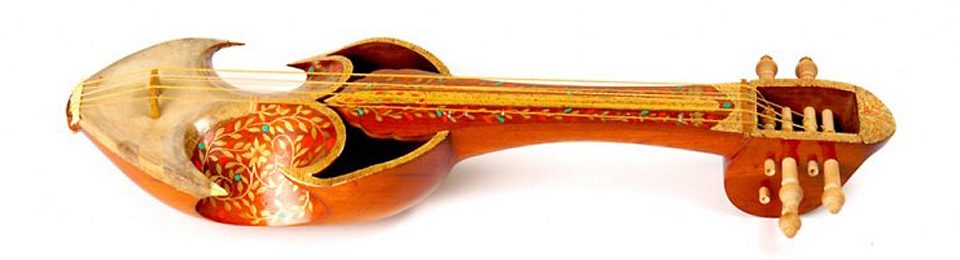
Meeting Sarangi Legend Pandit Ram Narayan

Tags

, , , ,

On May 30, 2016, Bhai Baldeep Singh, Chairman, The Anad Foundation, visited the residence of one of the world’s living legend sārangi maestros, Pandit Ram Narayan. Pandit Narayan speaks chaste Punjabi having worked at All India Radio (AIR), Lahore, until the partition of 1947. This visit was more about Pandit Ji hearing some of the ancient compositions of Gurbani and Khandarvani Dhrupad.

Here are some images that Bhai Baldeep Singh took of the maestro and his illustrious son, sarod maestro, Pandit Brij Narayan.

Gurbani Sangeet Retreat Review: By Nihal Singh

Nihal Singh’s Review

Happy are the moments spent in the company of an ustād. Their measure is not in their number, but in the quality of the fruit they bear for years to come. During such happy moments, the student—sedulous as he may fancy himself—struggles vainly to cup the subtle and ever-new torrent before him.

When it has passed, he finds the soil of his mind supple and primed for the strenuous tilling of riyāz. He realizes that his fingers are still cupped, and peering into the bowl before him, discovers that he holds not the torrent, but a glistening piece of fruit.

This composition is the student’s to weigh , to trace its contours, to contemplate its hue. It is his privilege and duty to do this, but he would be remiss to then lay the piece of fruit aside as a memento, or else to establish it as an idol. There is nothing to do now but eat it.

He savors the subtle torrent of the fruit’s nectar, and the tilled soil welcomes its seeds. The fruit is no longer before him, but within him. It is a drop in a subtle stream that may someday ferry fruit. But in the meantime, the fruit is his to bear at will—and how wondrous is its ever-new nectar!

Tuesday, February 16, 2016
University of California, Berkeley